TV shows and movies about female empowerment always seem to fail in some way as dramas. Maybe it’s because we generally expect everyone in a drama to be at each other’s throats or maybe it’s because we expect real-life to be full of failure, but anything in which everyone is heart-warmingly co-operative and in which the plucky underdog manages to triumph against the odds – and those who would oppress her – never feels truly authentic.
It doesn’t help that ’empowerment’ has been co-opted as by marketers for just about anything. What Women Want is ruined by many things – including Mel Gibson – but its relentless attempt to persuade you that Nike Women is really all about empowering women rather than extracting cash from them in exchange for over-priced trainers is downright nauseating. And that’s before we get onto anything in which stripping, pole-dancing, posing for naked calendars, beauty competitions et al are portrayed as actually completely liberating experiences, not exploitative, you sexist.
The first season of GLOW was therefore something of a rare beast. At first, little more than a sub-comedic drama set in the 80s world of women’s wrestling – being very loosely based on the genuine show Gorgeous Ladies of Wrestling – it rapidly evolved into a hymn to ineptitude that sees failed actress Alison Brie (Community) working with equally failed schlock film director Marc Maron (Maron) to try to put together a viable pilot for a show about female wrestlers that, really, just isn’t that good. There are terrible storylines, all the women end up playing terrible stereotypes (eg suicide bombers, ‘welfare queens’, evil Russians, members of the Ku Klux Klan) and no one’s actually any good at wrestling or even acting. And at no point doesn’t anyone try to argue that what they’re doing will close the pay gap and end discrimination as we know it
The first season took a little while to get into gear, it has to be said. Mild guffaws, for sure, but it wasn’t until episode seven when they’re actually shooting the pilot that we got some genuine comedy and the season started to come together.
Zoya the Destroyer
Season two
So expectations were… mild for season two. More gentle comedy while a group of slightly diverse women learn to get along together while fighting one another?
Pretty much, yes. That’s what season two is. But let’s not knock that. There are worse ways to spend your time by far, and there is one episode of absolute genius, too.
It’s “What have you been watching?”, your chance to recommend to fellow TMINE readers anything you’ve been watching this week
It’s been a relatively quiet week for global TV. July 4th has a lot to do with that in the US, July 1st in Canada, and I’m sure everyone everywhere else is just outside a lot at the moment, anyway. There are more new shows on the way soon, but for now, it’s been quiet.
That gave me enough time to finish off and review Marvel’s Luke Cage (Netflix) and I’m now about midway through the second season of GLOW (Netflix), upon which I shall report next week. I’ve also had enough time to wade through the first two episodes/three hours of Paramount (US)’s modern-day, Kevin Costner-infused cowboy-fest Yellowstone, which I’ll review after the jump.
We’ll also be talking about the latest episodes of Marvel’s Cloak and Dagger, Condor and Shooter, as well as the season finale of Mystery Road and series finale of Bron/Broen (The Bridge). Isn’t that irresistibly exciting? Then come follow me!
Season one of Marvel’s Luke Cage was the first sign that not all of Netflix’s superhero shows were going to be top-notch. Season one of Marvel’s Daredevil was something of a classic, in terms of both ultraviolence and as an investigation of the morality of vigilanteism. Meanwhile, season 1 of Marvel’s Jessica Jones was an unexpected deconstruction of the entire superhero genre and power.
However, Luke Cage was a bit meh. Perhaps it was too faithful to its 70s source material. Perhaps it was too much of an homage to blaxploitation movies. Perhaps it spent too long on its musical interludes. Perhaps it spent too little time on plotting, given how fractured the storyline was across the season. Perhaps it was too concerned with political arguments, with Cage the composite epitome of every black cultural stereotype being asked to solve the insoluble question of how a modern black man should act with honour – despite being bulletproof. Whatever the cause, it wasn’t as bad as season two of Daredevil or The Defenders, but it wasn’t great.
Given that there’d been no change in showrunner between seasons, I wasn’t expecting much of this second season of the show. Yet, actually, despite a somewhat downbeat ending, it’s the season I’ve enjoyed most since that first season of Jessica Jones. Apart from Iron Fist of course – screw you, haters.
Luke Cage uncaged
Season two of Luke Cage is a far jauntier, far more fun, far less self-conscious affair than the first season. Most of the same elements are there, but they fit together a lot better, everything’s more polished and it doesn’t feel quite so isolated from the larger Marvel universe.
Events continue more or less where season one left off, although this is clearly a post-Defenders story. Luke is, of course, out of prison and now everyone knows he’s a bulletproof superhero, making him the star of Harlem. Rappers are writing songs about him, he’s getting invited to show off his might against the NFL, Nike want to sponsor him – Luke Cage is big.
Meanwhile, Mariah (Alfre Woodward) is as big within the criminal underworld, thanks in part to the help of her lover-lieutenant ‘Shades’ (Theo Rossi). However, a new man is in New York from Jamaica calling himself ‘Bushmaster’ (Mustafa Shakir) and he has eyes on Harlem for himself. However, not only is his mission more personal than it first appears, he’s as strong and as bulletproof as Luke Cage. Is there room in town for the two of them?
Fortunately, Luke’s got help from the initially one-armed Misty Knight (Simone Missick), Claire Temple (Rosario Dawson) and, of course, the Immortal Iron Fist (Finn Jones). Screw you, haters.
It’s “What have you been watching?”, your chance to recommend to fellow TMINE readers anything you’ve been watching this week
So it turns out that season 2 of Marvel’s Luke Cage is 13 episodes, which makes my ambition to watch it all last weekend very ambitious indeed. I’m up to episode 9, though – spoiler: it’s better than the first season – but it’s probably not going to be Monday now until I can review it. Sorry about that.
However, I did manage to review Strange Angel (US: CBS All Access) and Take Two (US: ABC), as well as pass a third-episode verdict on Condor (US: Audience). I’ll also be reviewing Yellowstone in the next couple of days. Which ain’t bad.
Meanwhile, after the jump, I’ll be looking at the latest episodes in the TMINE viewing queue of Bron/Broen (The Bridge), Marvel’s Cloak and Dagger, MysteryRoad and Succession, as well as the season finale of Westworld and the return of Shooter. All that in a mo.
In the US: Thursdays, 10/9c, ABC
In the UK: Not yet acquired
Sometimes an idea appears to have a certain currency. Take the idea of famous actors who’ve played cops on TV shows deciding to apply their ‘knowledge’ to real life. Thirty years ago, you could watch that idea in first the BBC’s Pulaski and then just a few months later in ITV’s The World of Eddie Weary.
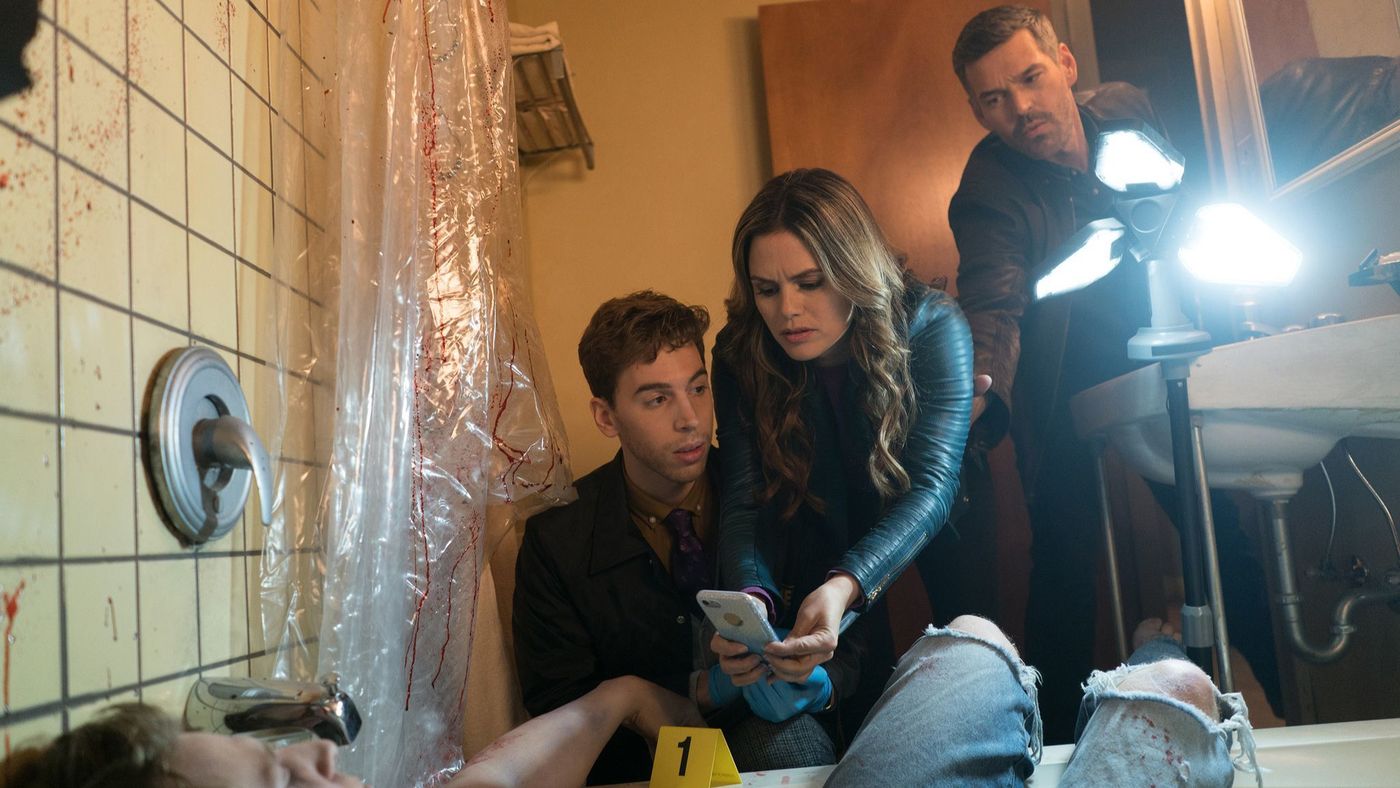
But right now, if you’re in Canada – and indeed the UK – you can watch that idea again in a show called Carter. And just a few weeks after Carter started, we have it again in the form of Take Two, in which Rachel Bilson (The OC, Hart of Dixie) plays the star of a successful TV cop show who torches her career when she finds her fiancé has cheated on her. As she’s looking for a new job, her agent gives her a movie script about a private investigator and suggests that to get into the role, Bilson should shadow the agent’s ex-boyfriend – seasoned cop turned private eye Eddie Cibrian (CSI: Miami, The Playboy Club) – for a week to find out what real-life is like.
Cibrian accepts in sufferance (and cash) on the condition that Bilson doesn’t butt in, but hey, guess what. Bilson butts in and soon they’re solving the case of disappeared-presumed-murdered young women, who might have ended up dealing with prostitutes and organised crime. Can Bilson bring any knowledge from her acting training, life in Hollywood and 200+ episodes of crime TV to bear, or will she prove to be merely a millstone round Cibrian’s neck?
No coincidence
So why do we have two shows with more or less identical premises on TV at the same time? Well, just as both Pulaski and The World of Eddie Weary were both written by the same man, thus explaining that not-coincidence rather simply, so this can be explained away easily, too – but in not quite the way you think. The reason? Carter and Take Two have nothing to do with each other, but the also not-too-dissimilar Castle got cancelled last year and its creator and executive producer, Andrew W Marlowe and Terri Edda Miller, were apparently in need of new work, so came up with this gender-flipped version of it.
In most variants of this formula, there is a marked tendency for the producers to point out the problems of TV crime fiction and how it differs from real life. Here, Take Two strays into difficult waters because although its reality and its in-show fiction are supposed to be different, were it not for a couple of costume changes, it would be impossible to know which is fiction and which is ‘real life’. They’re indistinguishable.
Cibrian is supposed to be a realistic PI, but despite being down on his luck and always turning in the bad guys before they’ve had a chance to pay him, he works in an office the size of Milton Keynes and can afford to pay a receptionist/hacker to provide helpful information when the plot demands it (Xavier de Guzman).
Dialogue is so gut-burstingly bad, you’ll wish you’d been infected by an Alien face-hugger since at least it would have knocked you out first.
Cibrian’s opening scene gives us his first client, a rich man whose car has gone missing.
Cibrian stares out the window of the expensive house. “It’s like the view from Mount Olympus,” says rich client behind him.
“I prefer the street myself,” says Cibrian.
“That’s why I hired you… So, have you found my stolen Margarti supercar?” the rich client says, helpfully explaining the plot to an audience who can’t look at photos as they may be doing something else that requires at least a good portion of the brain.
Cibrian then explains how rich client had actually stolen it himself. Rather than simply saying, “F*ck off” or “Dude, I didn’t hire you for this BS. Now f*ck off,” rich client then prevaricates as though he’s not actually a human being, but a character in a pre-arranged series of formulaic interactions that aren’t even really applicable to a situation involving a PI and his client, rather than a cop and his suspect.
Given that, could you have predicted that Cibrian’s first scene with Bilson involves him mouthing off about her to his ex before uttering the immortal line, “She’s right behind me, isn’t she?” Of course you could. You’re not stupid. Which means this show isn’t for you.
Similarly, the plot is 100% predictable. You don’t need even five seconds to work out why the girl has disappeared, once you find she’s been going around town asking questions about someone (duh, maybe she’s looking for someone, rather than interviewing to become an escort as we’re expected to believe for about half the show’s runtime). And because Bilson needs to have some worth to the show, Cibrian ends up looking like an idiot, having less than the minimal understanding of body language, etc, required by a former police detective to have been able to have done his job – thank goodness there’s an actress around who can read when someone is tense!
Formulaic
There is one small glimmer of light in all of this – Jordan Gavaris, whom you may remember as Felix, the guy with the nails on a blackboard English accent from Orphan Black. He plays an English coroner called Mick English.
Think about that for a second.
Gavaris, unlike the rest of the cast, does at least have some comedic timing and acting ability and given his accent went from “Oh my God, I remember that crap accent. It’s him off Orphan Black” to “Hmm, maybe I was too quick. Is it the same guy? Is he actually English?” in the space of one minute and stayed there, I could at least imagine watching the show on fast-forward just to see him occasionally.
Well, I can imagine it at least.
At the end of it, of course, Bilson and Cibrian end up working together permanently, because now new clients demand she’s around if they’re going to hire Cibrian, making this effectively a bit of a Remington Steele remake, too, or perhaps even Moonlighting, rather than merely just Castle for idiots. But why subject yourself to more of the same when you can watch a moderately better version of the same show with Jerry O’Connell?