US TV

Review: Rush Hour 1×1 (US: CBS; UK: E4)


In the US: Thursdays, 10/9c, CBS
In the UK: Acquired by E4. Begins 9pm, April 19 (probably)

The original Rush Hour, a 1998 action comedy in which black US cop Chris Tucker forges an unlikely buddy-buddy relationship with Chinese cop Jackie Chan, was a huge hit, earning US$244m at the box office as well as two sequels. The big mystery was why. Why was this most average of movies such a big hit?

Tucker, after all, is a candidate for an award for ‘most annoying human being on the face of the planet’.

Chan, of course, is great. Or at least was, back in his 1980s Hong Kong heyday. But in Rush Hour, older and, as with most Asian action cinema stars In Western movies, slower, he’s not that impressive. He’s still Jackie Chan but he’s no Drunken Master any more, certainly.

Then there’s the script, which is borderline offensive most of the time.

And lastly (well, I could go on, but I won’t) there’s Brett Ratner’s average direction, Ratner as we’ve already established being the world’s most average directorRush Hour in no way disproved this theory.

It’s just blah. So why so popular? I can only assume that it was either Chan’s mere presence in a movie or the fact it had a black and an Asian lead, was enough to make audience hungry for such mainstream rarities willing to watch pretty much anything – much like men in deserts with nothing to drink for days will imbibe almost anything they’re given, even Irn Bru.

If only there were a way to test.

Guess what. There is. It’s Rush Hour, CBS’s ‘reimagining’ of the original movie. Again, why bother, given how average the original was? I’m not sure, but that boat has sailed already. It’s here. Now we have to deal with it as it puts into port.

Rush Hour the series sees London’s own Jon Foo (from Jackie Chan’s own House of Fury) in the Chan role of a Hong Kong detective coming over to the US to investigate the theft of some terracotta soldiers on loan to a Los Angeles museum… as well as the murder of his cop sister. He’s partnered with LAPD detective Justin Hires (21 Jump Street) and wouldn’t you know it, there’s a clash of cultures, as the straight-laced Foo has to deal with Americans and their way informal ways, Hires having to adapt to the Chinese habit of kicking everyone else in the head every 10 minutes. Together they have to form a partnership to take down the bad guys, and wouldn’t you know, it by the end of the pilot episode, they’re partners for real.

Now you’d think that bereft of Tucker and Ratner, the Rush Hour format could only get better. But no. While Hires isn’t even a fraction as annoying as Tucker, he’s an appalling and uncharismatic actor. His dialogue might not be as overtly racist as Tucker’s was in the movie, but appropriately enough, he still sounds like he’s been given a black 90s stand-up’s lines (“You see white people? They go like this… You see black people? They go like this…”).

Meanwhile, it’s a little unclear whether Foo is simply taking “stiff and formal” a little too literally and behaving like he’s made of formica or if he simply can’t act. To his credit, he’s clearly a good martial artist, but he’s only technically good, capable of hurting people fluidly, but not charismatic or entertaining. Despite one or two attempts to go full Hong Kong with props, this is certainly not the new Martial Law.

It’s not even Into The Badlands.

Otherwise, despite the CBS budget, this is straight to syndication B-material, the sort of thing that makes you yearn for the days of The Adventures of Sinbad and Queen of Swords. No one’s trying very hard with the plot or the action scenes, the dialogue tries to be a bit racist but its heart isn’t really in it, and the supporting cast are more watchable than the leads but only just.

It’s not terrible: you can have it flicking across your TV screen, grabbing 8% of your attention while you do a crossword or repot some plants, and you won’t feel motivated to slit your own throat or even change channel. But there’s literally nothing to recommend it, nothing for you to highlight as a reason to watch it if anyone asks.

So if it succeeds, I think we can put it down to the scarcity of stories with black and Asian leads; if it fails, we can all appreciate how even on his worst day, Jackie Chan was just box office dynamite.

George Lopez in Lopez
US TV

Review: Lopez 1×1 (US: TV Land)

In the US: Wednesdays, 10/9c, TV Land

There was a time when watching stars play fake versions of themselves in comedies, particularly eponymous comedies, was almost daring. Gasp! They’re mocking themselves! Gasp! They’re doing bad things! Gasp! He’s roped in all his mates to do the same thing!

I can’t remember exactly when that time started – The Larry Sanders Show, maybe? – but if you think about how much fun Patrick Stewart was in Extras, for example, you’ll know what I mean. However, it’s pretty much definitely finished now. Thanks to the likes of Hoff The Record and Donny!, just the sight of an eponymously titled show makes we groan inwardly. Can’t they think of anything new to do? Do they think this is still daring? Can’t they think of some actual lines or funny situations that don’t rely on the star playing themselves to yield the laughs?

Certainly, that’s how I felt going into Lopez, TV Land’s new comedy series starring George Lopez. I mean, I’d not even heard of him, so how funny was this going to be?

Surprisingly, the answer is quite funny. Not hilarious, but still funny and in fact frequently incisive. As you might have gathered, the shows sees Lopez, the star of many previous eponymous shows including George Lopez and Saint George, playing a version of himself who’s rich, famous and living the celebrity lifestyle in Los Angeles. He sends his daughter to an expensive private school – so expensive, it actually has its own valet service – and he has lots of similarly rich and famous friends, including Snoop Dogg (or should that be ‘Snoop Dogg’ in this instance?). 

He’s also got problems with his white neighbours who think that everything he says is racist. He’s got problems with the esteemed former mayor of Los Angeles, Antonio Villaraigosa (‘Antonio Villaraigosa’?). He’s also got problems with Snoop Dogg, as well as a black friend of his, who doesn’t want to bid for him in a ‘celebrity assistant for a day’ auction to raise money for the private school.

In a summary, that doesn’t quite work and that’s in part because the writing is more about details. Sometimes, it’s simply knowing what it’s talking about in detail, such as when Lopez has to deal with his young manager as they negotiate for an endorsement from a young Vine star

Manager: I’m trying to see if he can go from 6 to 15.

Lopez: I don’t understand that.

Manager: 6 seconds is how long a Vine video can be, 15 is how long an Instagram video can be – I want to see if he can still hold the audience’s attention.

Lopez: You’re kidding?

Manager: You’re right. 10 might be better – I should consider Snapchat.

It’s when Lopez’s spoilt daughter is objecting to his appearing in the auction (“Can’t you just give them a château or a private chef like all the other parents do?”). It’s the references to black and Mexican culture and the various societal rules (“I can’t bid for you in an auction: that would be like that Disney cartoon where Goofy owns a dog”). It’s the meaningless phrases that Snoop Dogg comes up with that baffle everyone, but they assume are just street slang.

To some extent, it shouldn’t be too surprising that Lopez is a lot better than you might have suspected – it’s created and written by John Altschuler and Dave Krinsky, who co-created Silicon Valley and King of the Hill. And there are sufficient laughs for me to definitely consider watching more. It’s also a lot more than yet another old guy gets angry at the world for its various perceived slights against him and is a lot warmer and nicer than those potted bits of comic misanthropy.

However, for you UK readers, the biggest problem is that watching it, if you’re like me, you’ll feel like how the average American must feel when they watch Downton Abbey – aware that there’s a lot of cultural niceties that the native audience understand instinctively but which are going over my head, yet not quite sure what they are. On top of that, Lopez himself is almost completely unknown here, so again, it’s like those episodes of Extras in which Ross Kemp or Les Dennis played themselves.

So although I’d say Lopez is actually pretty good and worth trying, I’m not sure I feel compelled to watch it in the same way I would with a more universal comedy. Give it a try, though – it might surprise you, particularly if you’re American and so might get a lot more from it.

US TV

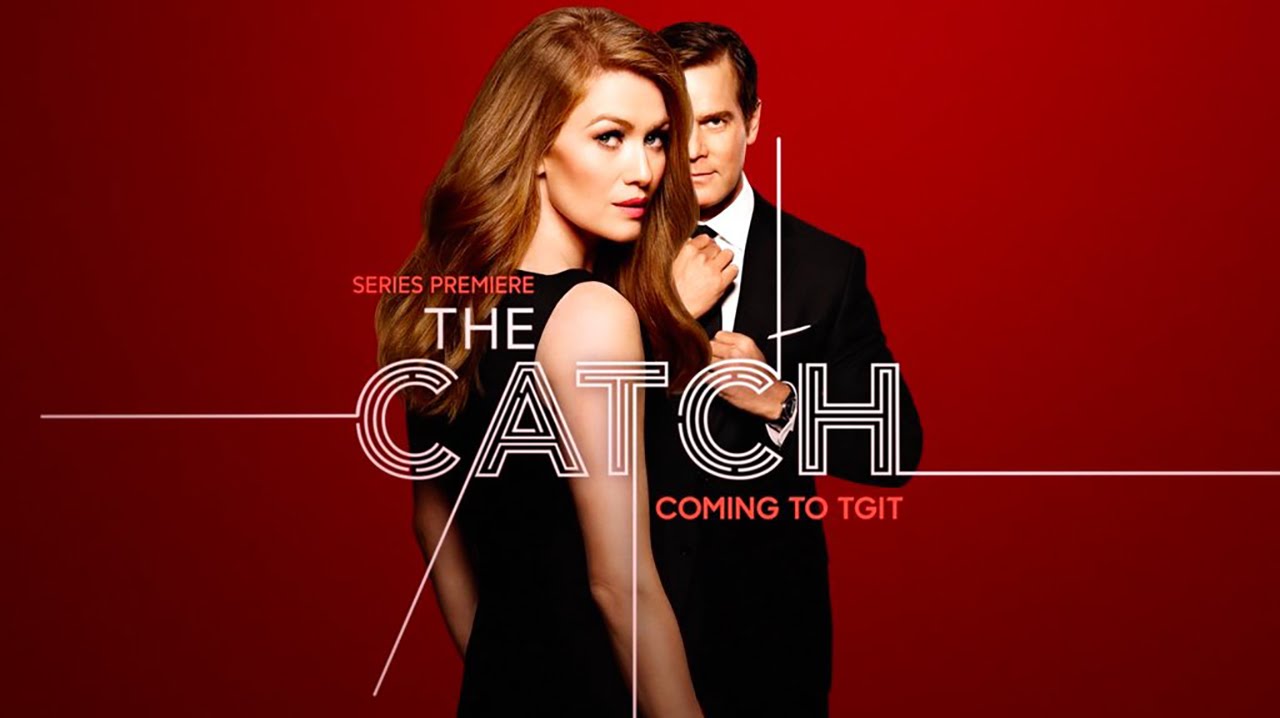
Review: The Catch 1×1 (US: ABC; UK: Sky Living)


In the US: Thursdays, 10/9c, ABC
In the UK: Acquired by Sky Living, for a probable May broadcast

Most art, particularly the hard-boiled kind, has been created by men. As a result, the femme fatale, that irresistibly alluring bad girl who leads the hero astray, is an established archetype throughout literature and movies. Think Lauren Bacall in The Big Sleep… if you want. I’ll be thinking of Sharon Stone in practically anything, particularly Basic Instinct where she played Catherine Tramell, whose name quite literally is a synonym for entrapment

But with women’s art increasingly recognised and women more often in a position of power, we’re seeing the increasing presence of the femme fatale’s male counterpart – the homme fatal, a term so obscure until now you have to go to the French wikipedia to even find it spelt correctly, and even then, it’s actually only the French title of Fanny By Gaslight

More commonly, you’ll find him referred to as the more manly ‘bad boy’ – you could probably write a thesis about why this should be – and such is the nature of the beast, he’s largely to be found in the fantasy and horror genre: think Angel in Buffy The Vampire Slayer or Edward in Twilight. He’s the sexy, elusive, frequently taciturn man of dubious virtue who sends the heroine off the rails and into a tail-spin. Like the femme fatale, he’s the one you f*ck, not marry; but unlike the femme fatale, he’ll probably fall in love with the heroine along the way.

Just as not every beautiful woman can be a femme fatale, not every handsome man can be an homme fatal. It takes a certain something more. A certain je ne sais quoi. Which is presumably why there’s been so much recasting on The Catch, ABC’s latest attempt to appeal to its predominantly female demographic through the all-powerful magic of Shonda Rhimes being cast on an homme fatal. I’m pretty sure it still hasn’t worked, though.

It stars Mireille Enos (The Killing (US), World War Z) as one of LA’s top private investigators, looking after the security for numerous big firms. She seems to have it all – a great business, great friends, great clothes, great house, a great taste in everything and a great fiancé (Peter Krause from The Lost Room, Dirty Sexy Money and Parenthood). Unfortunately, one of those turns out to be significantly less great than previously suspected. Have a guess which one?

Yes, it’s Krause. He’s actually a conman who’s trying to liberate all manner of things from Enos, except her spinsterhood, before he legs it with his real love (Sonya Walger from Lost, FlashForward, and Common Law). Will Enos discover what he’s up to before it’s too late and he breaks her business and her heart? No. Obviously not. Short show if she does. Instead, Enos has to do all she can recover her losses, save her business and catch Krause before FBI investigator Jacky Ido (Taxi Brooklyn) discovers everything.

As I said, there’s been a lot of recasting. Here’s the original cast picture:

Original The Catch cast

You’ll notice that Walger was originally Bethany Joy Lenz and Krause was Damon Dayoub. You can see them in action in the original pilot episode.

Since then, the show’s been retooled quite substantially. Gone is the noirish tale of angsty fraud investigator having doubts about her marriage who’s duped by a bad boy; now we’re getting some Shondaland kick ass fun – and a whole new man:

Harking back to that thesis I mentioned earlier, there was apparently either too little homme fatal to Dayoub and he wasn’t considered ‘substantial’ enough to be irresistible to Enos or there was too much to him and he was considered too sexy for prime time. Alternatively, it might be he was even thought too young for her – femmes fatales are almost always younger, hommes fatals are almost always older, of course.

Whatever the reason, in this all-new The Catch, Krause and Enos’s relationship is now a bit more Thomas Crown Affair, right down to the split-screen storytelling. Krause is ambivalent about the con against Enos and might well have fallen in love with her, having reservations about Walger who’s now the driving force in both their relationship and their con.

What’s surprising about the retooling is that the new first episode pretty much wraps everything up. You wonder where the show’s going to go next. By the looks of it, it’s going to be The Thomas Crowne Affair every week, with Krause, Walger and their partner in crime Alimi Ballard (Numb3rs) pulling another light-hearted con against one of Enos’ clients that Enos has to then stop, making Krause wonder if he’s actually in love with her and Enos having to resist his pull. 

Stapled onto that in a way that makes Women’s Murder Club‘s ‘corridor of truth’ look like seamless story-telling is all the sitting around, talking about boys.

The question is will you have a fatal attraction to The Catch? Probably not. While there is a lightness and simplicity to it that’s welcome after the likes of How To Get Away With Murder, it’s not in the slightest bit convincing. Krause is a lot of things, after all, and was great in The Lost Room. He’s also fun to watch and good at comedy. But an homme fatal? No. Sorry.

Enos is sparky and her job is thankfully a bit more dynamic than the usual mousey librarian with imposter syndrome that the genre requires. But she’s taking everything a bit too seriously for us to really enjoy watching her and, like much of the show, the idea of a super-rich security firm that has access to all its clients’ bank accounts is as crazy as a wardrobe full of screaming gibbons – the writers have to add dialogue at every point to patch up each blindingly obvious loophole they’ve just created.

The Catch is not the worst thing you’ll ever see, but unfortunately, despite some interesting ambitions, it’s unlikely to ever steal your attention, let alone your heart.

US TV

Review: Heartbeat 1×1 (US: NBC; UK: TLC)


In the US: Wednesdays, NBC
In the UK: Acquired by TLC. Starts in April

US medical dramas seem to fall into one of two categories: the realistic and the utterly unrealistic. Think ER and Code Black in the first camp, think Grey’s Anatomy and House in the second.

The fact that House is in the second camp should be a clue that being utterly unrealistic isn’t a bad thing. Given a lot of people die from all manner of unpleasant things in hospitals, unrealistic can be a good way to salve the viewer’s wounds by actually having everyone live. You can also have a lot of fun with unrealistic. You can even do smart things with unrealistic. 

Heartbeat is a different kettle of fish. Despite being based on the memoirs of a real-life heart surgeon, it appears to be so unrealistic it operates in some alternative universe. A very stupid one.

Melissa George – you may remember her from Home and Away, The Slap/The Slap (US), Hunted, Alias, In Treatment – plays a top heart surgeon and CIO. Yes, CIO. I’m assuming that means Chief Information Officer in the Heartbeat universe, as it does in ours, but you never know. That means she’s in charge of IT for her hospital, and so as well as performing heart transplants, presumably she also does a nifty line in organising service-oriented architectures, iSCSI SANs and business continuity fallover options (“Make sure the back-up data centre isn’t in our floodplain! And stat!”).

She’s the kind of top heart surgeon/CIO who can raise $150 million in a single day for her hospital while still caring about every single heart in her care. Which is amazing, obvs, but wasn’t the first clue I was seeing signals broadcast from a parallel universe.

That was in the first two minutes when George gets on plane to go to a conference, where she’s to deliver the keynote address. Unfortunately, she finds someone is already sitting in her first class seat. She has her ticket with her, but despite the fact there is literally no way these days for said seat to be double-booked, she ends up in coach.

Then, wouldn’t you know it, she has to go back to first class to administer emergency chest surgery with a razor blade – how did they get that on board on the plane? – to the man who was in her seat. But because she’s now covered in blood and doesn’t have a change of shirt, she has to deliver the keynote… dressed in one of the air hostesses’ 1960s-themed uniforms that she’s borrowed!

Oh my. What a quirky universe. I wonder how many fundamental forces of nature it has. There’s probably a ‘weak clown force’ mediated by the custard pion, at least.

Back at the hospital, George suddenly finds herself operating in a flashback romcom. There, the equally Australian Don Hany (Serangoon Road, Childhood’s End), a surgeon and former flame of George, has just returned, complicating things with the between one and three current and ex-boyfriends/husbands inhabiting George’s life.

We flash back to their first meeting a decade ago when she wore what in this universe would be the world’s most ridiculous wig. The very Australian Hany knew her dad and is surprised that he can understand the very American-sounding George, given daddy’s accent. “Yes, I’ve been trying to lose my cockney accent… mate,” says George.

Wait… what? Is this a joke between Aussies or something? Or is George supposed to be English woman assimilated as an American, rather than an Australian woman assimilated as an American? Is her dad a cockney and in this universe, not only can Australians not understand cockneys but cockneys say, “Mate”? Does that mean Australians don’t say ‘mate’ in this universe?

And so the clues piled up. Soon George is on the roof trying to talk down someone who is going to commit suicide so that his organs will go to a relative. “But wait, Mr Suicide!” says George. “If you jump off a building, the fall will compress all your organs and I won’t be able to use them!”

“Good point,” says Mr Suicide, who promptly takes out a gun and shoots himself in a head. Whoops! Maybe leave it to the pros next time, Melissa, who, to be honest, doesn’t seem that upset about seeing a man blow his brains out right in front of her. I suspect a degree of sociopathy here.

How did Mr Suicide get the gun through all the security? Why did he even think to take the gun with him if he was going to shoot himself in the head? Apparently, there’s also a ‘strong clown force’ and it makes people think in very different ways in this universe.

The trouble with setting a medical drama, rather than an out-and-out comedy, in a universe so clearly very different from our own is that it’s hard to take it seriously. This isn’t medicine as we know it. These aren’t plausible people. They may not even be human. We might as well be watching Doctor Dog, a heart-warming show about a gruff Irish Terrier and his pioneering asthma treatments for gerbils.

It’s a shame, because I like George, Hany’s a brilliant actor and it’s good to have another show with a female lead that isn’t just about her love life. But Heartbeat is beyond resuscitation. 

Streaming TV

Season review: Marvel’s Daredevil (season two) (Netflix)

In the US/UK: Netflix

While the Marvel Cinematic Universe has been going great guns for the past decade, the Marvel TV world is in a sorry old state, isn’t it? Marvel’s Agents of SHIELD was largely unwatchable in its first season until Captain America: Winter Soldier gave it a twist that made it really rather good… until the end of the season. Then it all went to pants in season 2 and I didn’t even bother with season 3. It’s about to get even worse in season 4, by the looks of it, now that the only two decent characters in the show are going to get their own spin-off series, Marvel’s Most Wantedleaving the dregs behind.

Meanwhile, Marvel’s Agent Carter, while having far more engaging characters than SHIELD and the delights of a post-war setting to play with, had soporific, unengaging storylines. As with SHIELD, a tie in with the MCU gave the first season a welcome twist – a glimpse at the Black Widow training programme in Russia, as well as of one of its graduates

But season two was so dull, I didn’t even make it through to the end and chances of the show being renewed are slender.

I did say ‘TV’ but Netflix is different. It’s not TV. Except in Eastern Europe.

Season 1 of Netflix’s Marvel’s Daredevil is one of the best shows the Internet TV provider has so far produced, while Marvel’s Jessica Jones actually managed to exceed it, while simultaneously deconstructing all the assumptions of the superhero genre. Very adult, unencumbered by the restraints of network TV, they make superhero TV shows – and many other dramas – look very inadequate.

When originally announced, Daredevil and Jessica Jones were both part of an attempt to do an MCU-style team-up on Netflix, with the first seasons of those shows to be followed by Marvel’s Luke Cage and Marvel’s Iron Fist to introduce those superheroes, and then by Marvel’s Defenders to bring them all together in one big show. However, both individually proved so popular – Jessica Jones was the top original streamed TV programme in the UK last year – that they’ve both been renewed for second seasons ahead of schedule.

And now, with Iron Fist himself only just getting cast, here’s season two of Daredevil, with blind but superathletic New York lawyer Matt Murdock having to deal with the fall-out from his quest against Kingpin last season, as well as his attempts to escape from his old mentor, Stick. But can the second season match the quality of the first, despite losing showrunner Steven DeKnight? Has it been rushed onto our computer screens too soon? And will Daredevil himself be overshadowed by the season’s two guest ‘superheroes’ – The Punisher and Elektra, both of whom have had their own movies?

Here’s a good batch of NSFW trailers for you to enjoy. Discussion after the jump: multiple spoilers ahoy, obviously, so probably best if you watch the entire second season first – unless you don’t care about being spoiled, of course.

Continue reading “Season review: Marvel’s Daredevil (season two) (Netflix)”