Today’s weird old title sequences are for The Avengers. You remember The Avengers don’t you? Steed, this dapper bloke in a bowler hat, and his lovely sidekick Mrs Peel fight weird sci-fi crimes together?
Kind of.
You see The Avengers changed a lot over its six series. Originally envisioned as a vehicle for rising star Ian Hendry from Police Surgeon, it began with Dr David Keel (Ian Hendry) investigating the murder of Peggy, his office receptionist and wife-to-be, by a drug ring. A mysterious trenchcoat-wearing stranger named John Steed (Patrick Macnee), who was investigating the ring, appeared on the scene and together they set out to avenge her death in the show’s first two episodes – hence the show’s title ‘The Avengers’. Afterwards, Steed asked Keel to continue partnering him when needed to solve crimes.
In this first series, Steed was the secondary character – he doesn’t even appear in some episodes. He also isn’t the dapper man about town we all grew to know and love, either. He was a hard-edged, ruthless character, willing to do what it took to get the job done, with Hendry’s Keel providing the moral centre for their work. In keeping with this blunt, down-at-heel approach, the show got some equally down-at-heel titles, with Hendry and Macnee lurking around on street corners in their trenchcoats, and – oh f*ck no – a jazz theme tune.
But slowly, the show began to change – and get a whole load more weird title sequences.
Britain is in crisis. Criminals are literally getting away with murder. Crime is common in Britain’s cities, and the ordinary decent citizen is scared for his or her life. What can be done?
Well the obvious solution, surely, is to create an autonomous criminal investigation organisation with minimal oversight, recruit agents to it from the police and armed forces, train them in commando tactics, arm them, then let them do anything they like, provided it catches criminals.
That solution’s sound as a pound, isn’t it?
Anyway, that’s the background to The Professionals, a late 70s/early 80s drama created by The Avengers supremo Brain Clemens and starring Lewis Collins, Martin Shaw and Gordon Jackson as Bodie, Doyle and their boss Cowley. Each week, these agents of CI5 would stomp around, either undercover or badges-flashing, and do whatever it took to stop those crims. Maybe get some heroin and threaten to addict a dealer if he doesn’t give them information.
Or how about release a hostage-taker’s brother from prison then threaten to shoot him in front of the hostage-taker if he doesn’t surrender?
Whatever it took.
Liberal nightmare though this was, it was an insanely popular show, the 24 of its day and far grittier, and in many ways better. Sure Bodie and Doyle could get away with murder if they wanted and the show’s attitude to women was beyond misogynistic, but their buddy-buddy relationship was well drawn and humorous, the show was incredibly well cast, it had a wonderfully catchy theme tune and it was written by people who knew how to plot to a tee.
So popular did it become that the army would frequently lend it weaponry in a pre Top Gun bit of boys’ toys-placement designed to inspire the nation’s young men to join up. And there are men today who would gladly drive a Ford Capri, purely thanks to its constant usage in four of the five seasons of the show.
To show you just how ridiculously action-packed it was, here’s a clip of one protracted stunt scene followed by… the weird old titles of The Professionals. Note the crashing car – there’s no reason for that; and Martin Shaw never once did Kendo (or whatever he’s pretending to do with that stick) in the whole series as far as I know.
Be still my beating heart. Ali Larter could be on her way to London next year to film a $150 million remake of Gerry Anderson series UFO, in which she’d play the part of Virginia Lake (more on her in a minute). I obviously don’t have pictures of that (yet), so here’s a picture and a vid from the first annual Los Angeles Gala, which was raising money for Friends Without Borders.
Significantly, though, this means we can have the first Random Acts of Ali Larter/Weird Old Title Sequences tie-in here on the blog. Because UFO had some weird old titles.
UFO
UFO was Thunderbirds creator Gerry Anderson’s first attempt at a fully live-action show. He’d had a sort of stab at it with Secret Service, in which Stanley Unwin voiced a puppet version of himself, but whenever they did a long shot, they’d just use live action footage of him instead. It was about as convincing as it sounds.
But UFO got Gerry Anderson into live-action proper. The plot to UFO was similar to that of other shows he’d done before, particularly Captain Scarlet: The Earth is under attack from an alien race. What for, we don’t know at first, but it soon becomes apparent they need us for our body parts.
Yep, they’re kidnapping us, stealing our organs, and transplanting them into their bodies. A later episode, The Cat With Ten Lives adds a little wrinkle to that, but all the same, it’s pretty sick and a great concept.
Naturally, when we humans find out about this, it being Gerry Anderson world, we come up with a top secret defence strategy and matching organisation: SHADO (Supreme Headquarters Alien Defence Organization). With submarines underwater that can launch planes, satellites called SID (Space Intruder Detector) in orbit for monitoring, a Moonbase that can monitor space for approaching UFOs and send out spaceships to intercept, and a whole load of ground-based attack vehicles, all it needs to be complete is a top-secret underground headquarters. Which it did – under Harlington-Straker Studios (really Pinewood) as a cover, of course, and not to save on production costs for the show.
Naturally, of course, because of all the powerful magnetic fields that the Moonbase equipment puts out, all the women running it up there have to wear purple wigs.
Still, everyone wore string vests down on the submarine.
A tussle The show itself was an interesting tussle between Gerry and Sylvia Anderson. On the one hand, Gerry wanted to do business as usual, and everything was going to be much as in Thunderbirds et al – that is, missions of the week.
Sylvia, on the other hand, wanted to do characters. She wanted to do stories that could be considered as drama. So the episodes of UFO vary between the same old plots you’d see already (Gerry’s stuff) and interesting ones, such as Confetti Check A-OK, which looked at SHADO boss Commander Straker’s guilt over the married he’d ruined (Sylvia’s stuff).
He’s a haunted man is Straker, channelling all his energies into his job, because he’s screwed up his personal life. In A Question of Priorities, he even sacrifices his own son so that the aliens can be stopped.
There’s also a slight disconnect because the show was shot in two filming blocks due to a change of studios. During the second block, which also saw a change in the writing department, George Sewell, who had played Straker’s second in command Alec Freeman during the first block, was unavailable. In his place came Wanda Ventham as the more memorable Virginia Lake. Because initially she essentially had a man’s lines – just like Cathy Gale before her on The Avengers – Lake was strong, tough and took no nonsense from Straker or anyone else. Because she’s a character who was co-opted at the last moment, she’s also notable for having been a research scientist in the pilot episode, a computer specialist and headed up Moonbase at one point.
From UFO to Space: 1999 The show didn’t do too badly, but it didn’t do as well as everyone hoped. By the time the second season was ready to go, it became clear it wasn’t going to pan out, even though the show’s creators had hoped a shift of focus to life on the Moonbase might have helped out.
So instead, Gerry and Sylvia decided to come up with an entirely new show set on the moon: Space: 1999, which I believe I’ve already covered.
On the whole, it wasn’t a great show, it has to be admitted. It definitely had its moments and in terms of plot, although not in terms of charm, it’s head and shoulders above Anderson’s previous shows as well as Space: 1999, although the latter trounces it significantly for production values. There are a few classic episodes, but no more than a handful, so I wouldn’t be buying too many from Amazon, if I were you.
Anyway, brace yourself for the weird old title sequence of UFO. In case I forgot to mention it, UFO was set in the then far off future of 1980, where all the fashions were strange and futuristic and the cars were just mental, too. But all of that gets explained in…
If they are going to remake an episode for the movies – for there are three planned – I’d recommend Mindbender, which involved everyone hallucinating because of a strange moon rock. Standout moments, apart from the fact Stuart Damon of The Champions is in it, is when Commander Straker gets affected and begins to hallucinate that his entire life is fictional and is being filmed as part of a TV series, masterminded by a woman called Sylvia. The clue, as they say, was in the episode title. You can watch the whole thing below. Aren’t I nice?
Have you seen Ali Larter acting randomly? If so, let us know and we’ll tell everyone about it in “Random Acts of Ali Larter“
Not especially weird, but today’s weird old title sequence is an example of just how good US title sequences used to be, but rarely are these days (notable exceptions: Dexter, Chuck and a few others). It’s Hart to Hart‘s.
Hart to Hart was one of the numerous private investigator shows that used to clutter the airwaves, but that have long since been replaced by police shows. Jonathan Hart (Robert Wagner) was – as Max his butler explains during the title sequence – a self-made millionaire; Jennifer Hart (Stefanie Powers) was his wife, a freelance journalist who now gets to enjoy the benefits of the multi-millionaire lifestyle (oh, if only).
When they met, it was murder, and pretty much every episode after that, there was a murder, too, which they solved in typically flamboyant style. Originally, it was a script by Sidney Sheldon about married spies, but Bond movie scriptwriter Tom Mankiewicz was offered the rewrite duties, with the instructions that he was to update it to make it more contemporary.
In retrospect, it was a slightly weird show. It aired in 1979 and Wagner and Powers hadn’t been true stars for some time: they were famous for shows of the 60s – It Takes A Thief and The Girl From UNCLE respectively.
But as you can probably tell from the fact that Cary Grant was first choice to play Jonathan Hart, taking advantage of a nostalgia amongst an older generation was the name of the game, something that also drove Murder She Wrote and Dynasty to ridiculous popularity. Also key to its success was the glamour of incredible wealth (cf Dynasty) and the fact it was a romantic programme that didn’t have a husband and wife at each other’s throats. Having said that, I remember watching it and loving it when I was about nine, so clearly it had a charm that appealed to all ages.
In combination with that charm, the chemistry between the leads and its knowing humour, Hart to Hart went on to 110 episodes, as well as reunion movies during the 1990s. Notably, the first episode didn’t show how Jonathan and Jennifer met – the show relied on this title sequence to introduce viewers to them until all was revealed in a later flashback episode set and filmed in London: Two Harts Are Better Than One – yes, there were a whole load of punning episode titles.
Ray Bradbury was one of those science-fiction authors who didn’t like science. He didn’t like getting bogged down in all those nasty facts and things that made his ideas impossible, so he ignored most of science altogether.
Which for his Martian Chronicles was a good thing, I think. Okay, so it did mean that Mars mysteriously became a world with an oxygen atmosphere that human beings could just walk around on without difficulty. But Bradbury was able to let his flights of fancy soar without being tethered or bogged down by pedantic little details.
The Martian Chronicles is an impressive name for what is essentially a set of short stories, linked mainly by their setting, rather than any particular theme, world view or overall story arc. It details humanity’s various attempts during the 20th and 21st century to settle on the planet of Mars, where they encounter a society of telepathic and extremely alien Martians.
The Martians initially try to repel the new arrivals, but eventually they’re all but wiped out by diseases brought by humans to Mars. Eventually, the humans themselves are wiped out on Earth by nuclear war, and find themselves becoming the new Martians and adopting the Martian ways.
The Chronicles themselves only really achieved coherence when they were collected together out of the various magazines they’d been published into a single volume – with some slight amendments such as the inclusion of ‘interstitial vignettes’ to make them fit together. It was this volume that was adapted by NBC and the BBC in the late 70s and turned into the mini-series The Martian Chronicles.
Although the stories themselves had no central hero, since they take place over a number of decades, for the mini-series, rocket pilot Rock Hudson becomes the hero, replacing the heroes of the various short stories that had them.
Like the stories, The Martian Chronicles is a meandering affair, aimless, taking absurd detours because it’s really an umbrella for all of Bradbury’s short stories. So we have the central plot of the colonisation of Mars and how it’s taking on all the worst characteristics of Earth, including gambling.
Then there’ll be a brief interlude where Hudson finds out his old friend Barry Morse has replaced his entire family with identical robots – Barry then dies, leaving his robotic family to carry on without him, unaware they’re robots. Which makes sense as a short story about what it means to be human, the nature of family, etc, but is utterly incongruous when placed with all the others.
It’s no surprise that The Martian Chronicles failed both critically and in the ratings, particularly since Bradbury himself described it as ‘boring’ in a press conference to launch the mini-series. But it still was a poetical piece, in which the ultimate action adventurer, a space rocket pilot, learns that true happiness doesn’t come from technology and action – that’s the kind of thinking that ends up with the whole human race and planet Earth destroyed in a war – it comes from being happy with oneself and in what one does. It also had stunning designs that really conjured the idea of an alien race with its own aesthetic and view of the world.
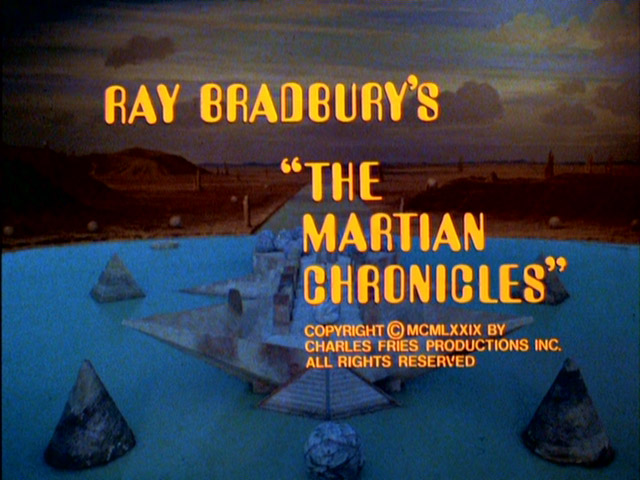
The titles are anything but dynamic, but they are one of the few examples of a poetic title sequence you’re liable to find, attempting to demonstrate the beauty, peace and calm of these imaginary Martians who died, leaving only ideas behind.