In the US: Sundays, CBS All Access In the UK: Acquired by More4. Will air in Spring
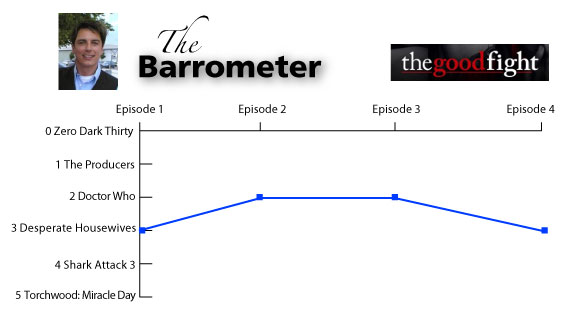
At the end of my review of the first episode of The Good Fight, a spin-off from The Good Wife featuring some of the less important characters as they face almost identical dilemmas to those faced by Julianna Margulies, I said:
I’ll probably give episode two a watch at least to see if takes the show in a different direction.
Guess what – it did. In fact, following that first episode, the show seems to have picked an entirely new plough to furrow. No longer is it simply about older lawyer Christine Baranski’s pension tribulations or young gay lawyer Rose Leslie having to live down her father’s possible involvement in said Ponzi-esque tribulations. Although these still make up about 50% of every episode, the show is now far more concerned with ‘the good fight’ of the title, looking about how the poor and disadvantaged are served by the US legal system and how C-list defence firms can actually make money.
And here, it’s actually very interesting. There are very strong hints that it knows what it’s talking about, more deeply and more knowledgably in fact than even Goliath. Trials aren’t won by emoting to a jury in the style of Chicago Justice but through application of real laws and consideration of legal principles. The good guys don’t always win, either. Unlike certain other shows, it’s not about what we’d like to be right, it’s about what the law says.
The show’s also intriguingly and explicitly post-Trump. While the first episode opened with Trump’s inauguration, that felt almost tacked on, rather than integral to the plot. Yet by the fourth episode, the firm is having difficulty with regular clients because it was clearly anti-Trump. There’s a trawl to find the one member of staff who voted Trump (Spin City‘s Michael Boatman), the show then making the point that by coming out as pro-Trump, he might well now be ostracised by the rest of the firm for the rest of his career. There’s also a constant refrain of ‘fake news’ lurking in the background.
Where The Good Fight gets a little thorny is a point I hadn’t noticed until this fourth episode – Baranski’s new firm is actually a minority-owned firm. Literally every character at the firm is black, apart from Baranski and Leslie, who then draft in another white Good Wife character (Sarah Steele) to help them out from episode two, despite the show almost immediately pointing out their new firm actually has a (black) investigator already.
Yet despite Delroy Lindo and Cush Jumbo being on hand, very little of the show is actually about them. They’re there, they’re involved, they even have rich white boy Justin Bartha (The Hangover) to woo them in Jumbo’s case, but the story’s following Baranski and Leslie, not them. It’s something the show will hopefully address and mull over in later episodes.
The Good Fight is probably the most interesting US legal drama I’ve seen in a long time. While it never achieves the chess-playing marvels of early Suits, it feels more real and more applicable to everyday life than that show did. However, its soapy back story is a millstone round its neck that I hope it can dispose of once it feels established. It also needs to do more with Lindo, Jumbo and Erica Tazel, who seems to exist purely to be the ‘black b*tch’ who resents Baranski’s presence among the partners. At the very least, it’s only by building up a good roster of its own characters that it can hope to achieve the longevity of The Good Wife.
Every nation has moments in its national consciousness that are not only important, they’re so important they take on the status of mythology and begin to transcend actual facts.
England has many of these moments, such as the Battle of Hastings – “The last time we were invaded! The English fought like dogs to defend liberty as we always do!… apart from during the Glorious Revolution when the Dutch invaded, everyone defected to the invading side and King James ran away to Faversham, leaving William of Orange to become the new king without having to fire a shot.”
For centuries, we ran around the world inventing concentration camps, committing genocide and war crimes, and partitioning countries arbitrarily, leading to all manners of disasters. But because we fought on the right side against someone even worse during the Second World War, we can ignore all that and decide not just that we’re the good guys now but that we have been and always will be, leading to Dr Liam Fox, our current Secretary of State for International Trade, to claim this week that “The United Kingdom, is one of the few countries in the European Union that does not need to bury its 20th century history.” Despite literally all the facts.
However, as I’ve said, we’re not alone in having these mythological, almost ‘cleansing’ moments that extinguish unhelpful facts. The US, for example, has its War of Independence, in which the bravy plucky colonists fought back against an evil empire (ie England) in the pursuit of liberty and freedom, establishing true democracy, which otherwise would never, ever have happened anywhere, let alone in the US.
Never mind that New Englanders in the 1770s were about the wealthiest people in the world, with per capita income at least equal to that in the UK and more evenly distributed. “No taxation without representation”? The average Briton in 1763 paid 26s a year in tax, while the average Masachusetts taxpayer paid just 1s. The Boston Tea Party? Organised by wealthy tea smugglers set to lose out thanks to a recent rebate given to the East India Company that made tea the cheapest it had ever been in America – as someone wrote at the time, “Will not posterity be amazed when they are told that the present distraction took its rise from the parliament’s taking off a shilling duty on a pound of tea, and imposing three pence, and call it a more unaccountable phrenzy, and more disgraceful to the annals of America, than that of the witchcraft?”
You can tell within just a few minutes exactly how faithful Making History is to actual history, when college professor Adam Pally (Happy Endings) returns to 1775 Lexington and discovers not only that Paul Revere hasn’t raced around on his horse screaming, “The British are coming! The British are coming!” but also that some “British soldiers” are now stationed in town.
Historically, of course, at this point in time, it wasn’t the plucky ‘Americans’ against ‘the British’ – everyone still thought of themselves as British, not Americans – so Revere actually warned that “The regulars are out!”, the regulars being the standard name for the British soldiers.
But that’s not what mythology says and for the rest of the episode, the regulars are about five seconds away from committing war crimes and inventing concentration camps a few centuries early à la mythology (cf The Patriot). They might do more if they ever learned that muskets and pistols needed to be reloaded after every shot in those days.
Still, Pally has travelled back in time inside a sports equipment bag so that he can woo Revere’s talented, forward-thinking daughter, Leighton Meester (Gossip Girl) by singing her Céline Dion songs he’s pretended to have invented. But by doing so, he has distracted Revere so badly, he has to drag history professor Yassir Lester back in time to 1775 to help sort things out and ensure the American Revolution still happens.
Yes, unlike Timeless, which largely wanted to be accurate while still upsetting the timeline, Making History is not really trying to do much more than play with US mythology in order to have a laugh.
The trouble is that it only knows how to do broad humour and even then, it’s not that funny. Sure, you have the absurdity of the duffel bag time machine and the singing, which raises a reasonable laugh. You have the idiocy of Pally, who jumps to the conclusion that he’s stopped the Revolution, because Americans are drinking tea in Starbucks and eating fish and chips in the local canteen when he returns to 2016.
But mostly it’s things like Lester vomiting copiously when he arrives in 1775 because everywhere smells like manure or because John Hancock and Samuel Adams trick him into drinking their ‘new beer’, which is actually the contents of the chamberpot.
Ho ho, if you’re still in middle school. Not so ho, ho for everyone else.
The show does at least try to deploy the occasionally more sophisticated joke, usually about an anachronism, although far less succesfully and it never surprises the audience with anything they don’t know already. But most of the time you have to rely on Pally’s performance to find any real humour in the show. Lester’s just there to gurn at Pally every time he does something unconscionable or dim, such as introduce him as “Queequeg”, a former slave who can only say “Hello”.
Meester’s plucky, doing what the incompetent modern men can’t do for themselves, speaking Dutch, firing pistols, riding horses and more. But she’s underserved by script – she’s less knowing, the constant source of historical information that’s always designed to counterpoint modern-day information the audience already knows (“We could buy a house together for $5!”), yet never getting to deliberately make jokes herself.
Making History is a nice idea at heart but poorly implemented, failing to do more than elicit a few cheap laughs with schoolboy humour and a few wry smiles when it does modern commentary. I have little faith that subsequent episodes, which promise travel to different time periods and the chance for Meester to crack her own jokes, will be that much better, but you never know.
Pally and Meester both deserve better, as does America, to be honest. Don’t you know it won the Second World War all by itself?
It’s been a week of movie spoilers for Wonder Woman fans since last we met. Members of the press have been allowed to see a couple of scenes from the movie and talk to director Patty Jenkins.
More importantly, they’ve been given the lowdown on the plot and it seems a certain French magazine got the wrong end of the stick about the film’s most important points as far as canon is concerned. IMDb is now prepared to reveal all (spoilers ahoy):
Something Diana does not realize at first, but the audience gets, is Diana’s true power as a demigod. Early on, the movie catches fans up on Amazon history, storybook style, telling of a time when Zeus ruled Earth and his jealous son Ares poisoned the hearts of men so they’d turn on each other. Zeus turned to other gods for help and Aphrodite created a race of Amazon warriors, powerful women with a mission to restore peace.
It worked for a while but Ares killed other gods and almost killed Zeus, until Zeus blasted him and created Themyscira. He left behind a “god killer” to the Amazons, the only weapon capable of killing Ares. But it’s not a physical object, it’s Diana, a demigod, herself, as the secret daughter of Zeus and Hippolyta (Connie Nielsen) — she is the weapon that can kill Ares.
The observant will notice a very important ‘almost’, the addition of a certain goddess to the plot, the restoration of an important origin point from the nu52 and a lot of new metaphors. It certainly sounds a lot better than the French version, anyway.
All in the real world, there’s been a brief interview with Susan Eisenberg, who of course voiced Wondy in the Justice League animated series and is set to do the same in the video game sequel to Injustice: Gods Among Us.
Not much by way of comics since last time, though. In fact, Justice League (Rebirth) #16 was the only one I could spot and even then, very little Diana. Indeed, all does it make clear what was hinted at last time: Diana has gone back in time to the (non-specific) age when the Olympians began.