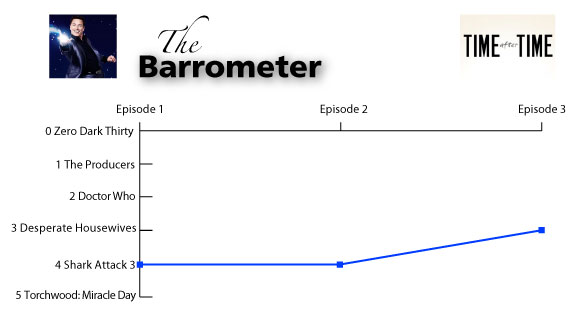
The BarrometerA Barrometer rating of 4

Third-episode verdict: Time After Time (US: ABC)

In the US: Sundays, 9/8c, ABC

I ended my review of the first two episodes of Time After Time – Kevin Williamson’s reimagining of the 1979 movie in which Jack The Ripper steals HG Wells’ time machine and journeys into present day New York, where Wells has to hunt him down – with a prediction. Given virtually the entire movie’s script had been exhausted by the end of the first two hours of the show, whither next for the series?

Maybe it’ll be “hunt the Ripper” every week or maybe it’ll start to explore Wells’ other novels… Everything’s to play for with episode three then. More of the tedious same or something a bit different. Has Williamson run out of ideas or does he still have some gumption? We’ll soon see.

However, we might have to wait a little longer to find out.

Episode three has two strands. The first half hour or so appears to set up Time After Time as the new Forever, with gentlemanly HG Wells (Freddie Stroma) and his quaint oldy-timey manners flirting away with insanely bland museum curator Génesis Rodríguez. Meanwhile, evil Jack the Ripper (Josh Bowman) continues the main theme of the first two episodes, by alternating between making threatening phone calls to Stroma and hacking various people to death. 

The unifying theme between the two? Marvelling at and being perplexed by modern technology, with Stroma delighted by the Internet, cars and talking SatNavs, Bowman excited by iPhones’ video capabilities and the burrito-heating properties of microwaves – if only he could find the button to open them.

It’s the second half of the episode that changes the show’s direction, since it quickly becomes apparent that literally everyone knows who HG Wells and Jack the Ripper are. Everyone. Because he’s got a time machine and in the future, he’s going to go back in time to their pasts and they’re going to find out about that somehow. And keep it a secret from him because he won’t know yet. 

Everyone? Really? Yep. That bloke who stalked Stroma in the pilot? He knows. That bloke’s mum? Even she knows. 

And that shifts everything. So, we’ve got some kind of odd conspiracy theory plot for Wells to deal with on the one hand. On the other, something odd is going on with Bowman. It looks like business as usual as he romances Jennifer Ferrin (The Knick, Falling Water, Falling Skies, Hell on Wheels), but then that goes in a very different direction than the one you’d expect.

All the same, despite this slightly surprising bit of plotting, this is still at heart the reasonably stupid, slightly unpleasant show of the first two episodes. As well as inventing the time machine, Wells apparently also invented lasers and quantum mechanics a few years early. Jack can viciously stab someone to death with a kitchen knife and not even wrinkle the suit he’s wearing, let alone get it bloody. The two of them speak almost fluent modern New Yorkese, and beyond one or two vestigial Victorian English manners like saying ‘please’ and ‘thank you’, appear to have entirely acclimatised through osmosis to modern American manners, too. Before you know it, they’ll be tipping a minimum of 20% without anyone telling them to, like some modern day Muad’dibs.

The leads are appealing, the subject matter is intriguing, but ultimately this is a very bad implementation of a potentially good idea. So I won’t be sticking with Time After Time any longer to see if it gets better. Or less stabby.

The BarrometerA Barrometer rating of 3

Third-episode verdict: Taken (US: NBC; UK: Amazon)

In the US: Monday, 10/9c, NBC
In the UK: Tuesdays, Amazon

Three episodes into NBC’s Taken, a prequel of sorts to the movie franchise, it’s now reasonably clear that the show wants even less to do with Liam Neeson’s European family drama than the first episode intimated. Instead, what it really wants to be doing is a slightly smarter version of 24, but without the full-on, balls-out belief in the efficacy of torture that being on the Fox network brings.

What it really doesn’t want to do is have prequel Liam (Clive Standen) acting in any way even remotely resembling Liam Neeson did in the movies. Things like being a father, working by himself for no-one but himself, having contacts. That kind of thing.

So, each week since the pilot, we’ve had our Clive off with his team, doing team things together, at the behest of boss Jennifer Beals. He’s not learning his very particular set of skills, either, since he already has them. Unlike in the pilot, though, there’s absolutely no reference to the movies, no foreshadowing, no characters who’ll show up in the movies.

Indeed, beyond the fact it’s called Taken and features ‘Brian Mills’, there’s nothing Takenish about it. Even Standen’s hint at a Northern Irish accent in the pilot has disappeared, perhaps suggesting it wasn’t deliberate, although getting him to be a soccer player in the third episode suggests the producers want to hint at some kind of European background, at least.

That said, the scripts are a lot less stupid, Standish is a vastly more compelling lead and the action scenes are about 1,000% better than those of 24: Legacy. Certainly, you can usually rely on each episode to serve up an unexpected fillip to a fight or a scene that you’ve never seen before in a TV show.

But other than that, in its foundations, it’s unremarkable. There’s nothing unique about its set-up, characters or scenarios that you won’t have seen in a dozen other TV shows. Characterisation is shallow, perfunctory and uncompelling, and there’s certainly nothing that makes you think, “Ah, that’s why Liam Neeson is so frightened of Paris in the movie!”, for example.

If you can get by purely on action scenes and the occasional signs of intelligence, Taken‘s worth a punt. If you miss 24 and find 24: Legacy an unsatisfactory replacement, give Taken a whirl. But if you need involving plots, dialogue and characterisation, Taken‘s not for you.

What have you been watching? Including Arrival (2016) and The Americans

It’s “What have you been watching?”, my chance to tell you what movies and TV I’ve been watching recently and your chance to recommend anything you’ve been watching.

Grrr. Aargh. Sundays. They really make this whole thing harder. As of last week, there was already The Good Fight, Billions, Time After Time and Making History, but now American Crime is back and there’s The Arrangement to watch, too. So, given I do actually have a day job and the whole of Marvel’s Iron Fist is coming out on Netflix this Friday, let’s face facts and accept I’m going to be a week behind with everything that airs on Sunday from now.

Soz.

All the same, Time After Time will be getting a third-episode verdict later this week, seeing as I reviewed the first two last week; and I’ll be casting my eyes over the first two episodes of The Arrangement (US) as well, so there is at least hope in sight.

Elsewhere this week, I reviewed the first episode of Making History and passed verdict on The Good Fight, which means that after the jump, I’ll be looking at the latest episodes of: 24: Legacy, DC’s Legends of Tomorrow, The Flash, Imposters, Legion, Lethal Weapon, The Magicians, Powerless and Taken, as well as the season finale of Man Seeking Woman. The observant will notice I haven’t watched Fortitude or Prime Suspect 1973 this week. Sorry about that, although it probably says something about both them that I haven’t pushed myself to watch either.

However, I did watch the first episode of the new season of The Americans, which I’ll also be covering after the jump. And in other news, I’m going to drop not one but two regular shows this week. Can you guess which?

I also managed to watch a movie at the weekend, mind.

Arrival (2016)
Mysterious aliens ‘the heptapods’ arrive on Earth, but they don’t speak Earth languages. It’s the job of linguist Amy Adams and theoretical physicist Jeremy Renner (a ‘Christmas Jones’ on the plausible casting scale) to try to learn how to communicate with them and find out what they want.

Arrival was heavily hyped as the new 2001 of intelligent science-fiction movies, so we went into this with high expectations, particularly given what language nerds lovely wife and I both are. Disappointed we were. Disappointed.

While there was a little bit about the difficulties of learning any language, this was a bowdlerised version of the original book’s linguistic intrigue…

The heptapods have two distinct forms of language. Heptapod A is their spoken language, which is described as having free word order and many levels of center-embedded clauses.… Unlike its spoken counterpart, Heptapod B has such complex structure that a single semantic symbol cannot be excluded without changing the entire meaning of a sentence.

…in much the same way as The Martian changed the original book’s constant Macgyvering-in-extremis into a far simpler tale of surviving against the odds.

Even so, despite some beautiful visual direction, Arrival is largely a film in which Renner and Adams repeatedly go into a room, see some circles, then go away again, interspersed with Adams thinking about her dead daughter. Tension and excitement there are not.

That said, there is a point in the movie when Adams finally learns the aliens’ language where Arrival comes together, everything becomes clear and the movie becomes a much more interesting piece thanks to a couple of properly genius ideas. There are a couple of scenes that probably will linger for a long time in the memory, too.

Not so much the new 2001, then, so much as the new (spoilers, because they’re very, very similar) Interstellar.

Continue reading “What have you been watching? Including Arrival (2016) and The Americans”

US TV

Review: Time After Time 1×1-1×2 (US: ABC)

In the US: Sundays, 9/8c, ABC

Kevin Williamson’s arm slumped to his side, the remote control loose in his grasp. The room was silent now, silent as a single tear rolled down his cheek.

“When Alexander saw the depth of his empire he wept for there were no more worlds to conquer,” he repeated to himself. “So right. Hans was so right.”

Williamson was inconsolable. He owed everything to serial killers. Everything. His entire career had started with Scream but how he wished that he could escape them now, to develop sweet, lovely little shows.

But every time he’d strayed, every time he’d tried to develop a Dawson’s Creek or Hidden Palms or adapt another young adult book to make a Vampire Diaries or The Secret Circle, he’d been forced to return to the minds of these misogynistic sociopaths. Scream 2, I Know What You Did Last SummerScream 4 and then The Following had all drawn him back in.

Except now The Following had been cancelled. What was he to do? Three seasons of The Following. Three! He must have exhausted every serial killer permutation in the book. Worse – people were becoming jaded with serial killers. They had… over-kill!

Williamson would have chuckled at that, if there had been even the slightest trace of joy in his life. There was nothing left. He ruled… nothing.

If only there were some way to make serial killers better, to truly catch the public imagination once again, just as they had all those years ago.

If a light bulb could have appeared about Williamson’s head, it would have done. All those years reading books hadn’t been for nothing after all! What if he could bring the most popular serial killer ever into modern times to save him? What if he could bring Jack the Ripper himself into the present day?

And he knew just how. He reached over to his bookcase and took out Time After Time by Karl Alexander. He opened it. In the hollowed out centre of the book was the DVD of the movie, Time After Time, written and directed by Nicholas Meyer.

He put the disc into the machine and pressed play on his remote control.

Yes, this will work. And he already knew how he could turn it into a TV series. Just with someone a bit hotter than Malcolm McDowell or David Warner…

Continue reading “Review: Time After Time 1×1-1×2 (US: ABC)”

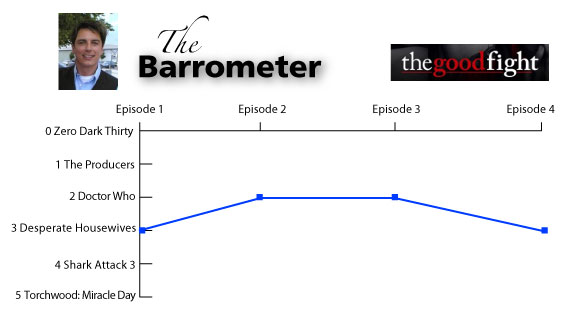
The BarrometerA Barrometer rating of 2

Fourth-episode verdict: The Good Fight (US: CBS All Access; UK: More4)

In the US: Sundays, CBS All Access
In the UK: Acquired by More4. Will air in Spring

At the end of my review of the first episode of The Good Fight, a spin-off from The Good Wife featuring some of the less important characters as they face almost identical dilemmas to those faced by Julianna Margulies, I said:

I’ll probably give episode two a watch at least to see if takes the show in a different direction.

Guess what – it did. In fact, following that first episode, the show seems to have picked an entirely new plough to furrow. No longer is it simply about older lawyer Christine Baranski’s pension tribulations or young gay lawyer Rose Leslie having to live down her father’s possible involvement in said Ponzi-esque tribulations. Although these still make up about 50% of every episode, the show is now far more concerned with ‘the good fight’ of the title, looking about how the poor and disadvantaged are served by the US legal system and how C-list defence firms can actually make money.

And here, it’s actually very interesting. There are very strong hints that it knows what it’s talking about, more deeply and more knowledgably in fact than even Goliath. Trials aren’t won by emoting to a jury in the style of Chicago Justice but through application of real laws and consideration of legal principles. The good guys don’t always win, either. Unlike certain other shows, it’s not about what we’d like to be right, it’s about what the law says.

The show’s also intriguingly and explicitly post-Trump. While the first episode opened with Trump’s inauguration, that felt almost tacked on, rather than integral to the plot. Yet by the fourth episode, the firm is having difficulty with regular clients because it was clearly anti-Trump. There’s a trawl to find the one member of staff who voted Trump (Spin City‘s Michael Boatman), the show then making the point that by coming out as pro-Trump, he might well now be ostracised by the rest of the firm for the rest of his career. There’s also a constant refrain of ‘fake news’ lurking in the background.

Where The Good Fight gets a little thorny is a point I hadn’t noticed until this fourth episode – Baranski’s new firm is actually a minority-owned firm. Literally every character at the firm is black, apart from Baranski and Leslie, who then draft in another white Good Wife character (Sarah Steele) to help them out from episode two, despite the show almost immediately pointing out their new firm actually has a (black) investigator already.

Yet despite Delroy Lindo and Cush Jumbo being on hand, very little of the show is actually about them. They’re there, they’re involved, they even have rich white boy Justin Bartha (The Hangover) to woo them in Jumbo’s case, but the story’s following Baranski and Leslie, not them. It’s something the show will hopefully address and mull over in later episodes.

The Good Fight is probably the most interesting US legal drama I’ve seen in a long time. While it never achieves the chess-playing marvels of early Suits, it feels more real and more applicable to everyday life than that show did. However, its soapy back story is a millstone round its neck that I hope it can dispose of once it feels established. It also needs to do more with Lindo, Jumbo and Erica Tazel, who seems to exist purely to be the ‘black b*tch’ who resents Baranski’s presence among the partners. At the very least, it’s only by building up a good roster of its own characters that it can hope to achieve the longevity of The Good Wife.