In the US: Thursdays, 10/9c, ABC
In the UK: Not yet acquired
Sometimes an idea appears to have a certain currency. Take the idea of famous actors who’ve played cops on TV shows deciding to apply their ‘knowledge’ to real life. Thirty years ago, you could watch that idea in first the BBC’s Pulaski and then just a few months later in ITV’s The World of Eddie Weary.
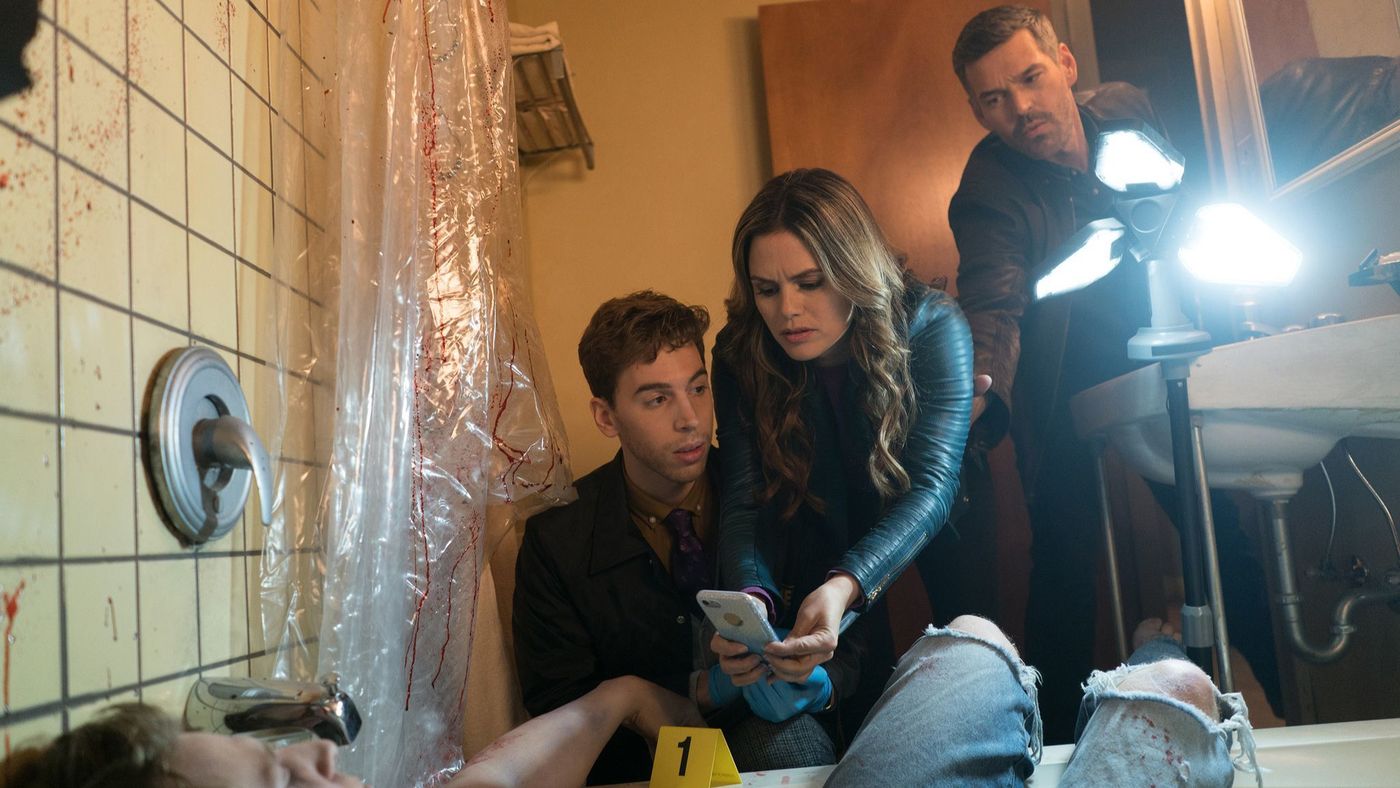
But right now, if you’re in Canada – and indeed the UK – you can watch that idea again in a show called Carter. And just a few weeks after Carter started, we have it again in the form of Take Two, in which Rachel Bilson (The OC, Hart of Dixie) plays the star of a successful TV cop show who torches her career when she finds her fiancé has cheated on her. As she’s looking for a new job, her agent gives her a movie script about a private investigator and suggests that to get into the role, Bilson should shadow the agent’s ex-boyfriend – seasoned cop turned private eye Eddie Cibrian (CSI: Miami, The Playboy Club) – for a week to find out what real-life is like.
Cibrian accepts in sufferance (and cash) on the condition that Bilson doesn’t butt in, but hey, guess what. Bilson butts in and soon they’re solving the case of disappeared-presumed-murdered young women, who might have ended up dealing with prostitutes and organised crime. Can Bilson bring any knowledge from her acting training, life in Hollywood and 200+ episodes of crime TV to bear, or will she prove to be merely a millstone round Cibrian’s neck?
No coincidence
So why do we have two shows with more or less identical premises on TV at the same time? Well, just as both Pulaski and The World of Eddie Weary were both written by the same man, thus explaining that not-coincidence rather simply, so this can be explained away easily, too – but in not quite the way you think. The reason? Carter and Take Two have nothing to do with each other, but the also not-too-dissimilar Castle got cancelled last year and its creator and executive producer, Andrew W Marlowe and Terri Edda Miller, were apparently in need of new work, so came up with this gender-flipped version of it.
In most variants of this formula, there is a marked tendency for the producers to point out the problems of TV crime fiction and how it differs from real life. Here, Take Two strays into difficult waters because although its reality and its in-show fiction are supposed to be different, were it not for a couple of costume changes, it would be impossible to know which is fiction and which is ‘real life’. They’re indistinguishable.
Cibrian is supposed to be a realistic PI, but despite being down on his luck and always turning in the bad guys before they’ve had a chance to pay him, he works in an office the size of Milton Keynes and can afford to pay a receptionist/hacker to provide helpful information when the plot demands it (Xavier de Guzman).
Dialogue is so gut-burstingly bad, you’ll wish you’d been infected by an Alien face-hugger since at least it would have knocked you out first.
Cibrian’s opening scene gives us his first client, a rich man whose car has gone missing.
Cibrian stares out the window of the expensive house. “It’s like the view from Mount Olympus,” says rich client behind him.
“I prefer the street myself,” says Cibrian.
“That’s why I hired you… So, have you found my stolen Margarti supercar?” the rich client says, helpfully explaining the plot to an audience who can’t look at photos as they may be doing something else that requires at least a good portion of the brain.
Cibrian then explains how rich client had actually stolen it himself. Rather than simply saying, “F*ck off” or “Dude, I didn’t hire you for this BS. Now f*ck off,” rich client then prevaricates as though he’s not actually a human being, but a character in a pre-arranged series of formulaic interactions that aren’t even really applicable to a situation involving a PI and his client, rather than a cop and his suspect.
Given that, could you have predicted that Cibrian’s first scene with Bilson involves him mouthing off about her to his ex before uttering the immortal line, “She’s right behind me, isn’t she?” Of course you could. You’re not stupid. Which means this show isn’t for you.
Similarly, the plot is 100% predictable. You don’t need even five seconds to work out why the girl has disappeared, once you find she’s been going around town asking questions about someone (duh, maybe she’s looking for someone, rather than interviewing to become an escort as we’re expected to believe for about half the show’s runtime). And because Bilson needs to have some worth to the show, Cibrian ends up looking like an idiot, having less than the minimal understanding of body language, etc, required by a former police detective to have been able to have done his job – thank goodness there’s an actress around who can read when someone is tense!
Formulaic
There is one small glimmer of light in all of this – Jordan Gavaris, whom you may remember as Felix, the guy with the nails on a blackboard English accent from Orphan Black. He plays an English coroner called Mick English.
Think about that for a second.
Gavaris, unlike the rest of the cast, does at least have some comedic timing and acting ability and given his accent went from “Oh my God, I remember that crap accent. It’s him off Orphan Black” to “Hmm, maybe I was too quick. Is it the same guy? Is he actually English?” in the space of one minute and stayed there, I could at least imagine watching the show on fast-forward just to see him occasionally.
Well, I can imagine it at least.
At the end of it, of course, Bilson and Cibrian end up working together permanently, because now new clients demand she’s around if they’re going to hire Cibrian, making this effectively a bit of a Remington Steele remake, too, or perhaps even Moonlighting, rather than merely just Castle for idiots. But why subject yourself to more of the same when you can watch a moderately better version of the same show with Jerry O’Connell?
In the US: Wednesdays, 10pm ET/PT, Audience
In the UK: Not yet acquired
In this day and age, it’s actually quite rare for a movie adaptation to stick relatively faithfully to the original. Condor, based on 70s ‘classic’ spy movie Three Days of the Condor, is one such beast that so far has followed the original’s plot pretty closely. Effectively a mash-up of the original movie, Rubiconand 24, it sees Max Irons playing a nerdy CIA analyst forced to go on the run when he stumbles on something he shouldn’t have and his entire office of co-workers gets killed.
Episode one wasn’t great, but it wasn’t bad and was probably better than the original Robert Redford movie. It was a bit off-kilter, not following the standard beats of spy shows, instead giving us something a bit more thoughtful than average while simultaneously a bit more stupid, as goodies and secret baddies debate the nature of morality in a world of amoral terrorism – should we continue to play by the rules or should we be taking the gloves off and trying to wipe out everyone without restraint? Weirdly, Brendan “George, George, George of the Jungle” Fraser is the bad guy, but he goes around not quite knowing how to be an evil villain. He hopes to wipe out the US/the Middle East/both (one of those is a spoiler) with some engineered bubonic plague, but he doesn’t actually like killing, he’s a bad manager and everyone but everyone pushes him around. Interestingly for a conspiracy theory show, we know from the beginning who the conspirators are, too.
Subsequent episodes have then been somewhat varied in theme, if not quality. Episode two was a far more exciting and less stupid affair than the first episode, with Mr Irons having to deal with implacable Terminator-like adversaries and generally not faring too well. However, my fears that all the good cast (eg William Hurt) were going to get killed off or written out in the second episode in favour of cheaper actors appear to be unsupported, fortunately, with episode three showing that at the very least, we might get two minutes of both Hurt and Mira Sorvino insulting each other’s balls every week, if not much more.
Episode three was the first episode to really exploit the potential of TV by making it not all about Max Irons. He’s in it, but here the focus is as much on the relatives of the deceased co-workers and their pain, as it is on Irons’ problems. One scene in particular, in which a CIA goodie (Bob Balaban) actually sits down and prays for someone after meeting them isn’t something I think I’ve ever seen in a thriller, showing Condor has the potential to be innovative.
Unfortunately, when Irons is around, the remnants of Three Days of the Condor work against him – it’s really not cool to go around abducting ex-dates and beating them up in their own homes in the #MeToo era and you can’t help but think that maybe the producers would have been justified in changing the original’s plot to bring it up to date (if The Bourne Identity could go do it, I don’t see why Condor couldn’t).
Conclusion
Condor is a pretty decent, if still chewing-gum infused piece of spying. It could do with losing some more clichés and the big hitting actors need to be allowed to do more than needle each other in offices, but it’s really a lot better than I was expecting and something I’ll be sticking with for the foreseeable future.