In the US: Mondays, 10/9c , CBS In the UK: Oh, the usual places. You know, Five, Five USA, Living – them lot
CSI: Miami, as we all know, is science fiction. It’s set in a distant future, where impossible science allows us to solve improbable, futuristic crimes with undreamt of techniques, and where a robot called Caruso (aka the Carusobot) is allowed to run a crack crime fighting team of scientist-cops.
Yet for the opening episode of this eighth season of CSI: Miami, in which the (not very) brain damaged scientist-cop Eric Delko is close to death and begins to hallucinate, we find ourselves cast backwards in time to the dim and distant past of 1997 where we discover how this crime-fighting team was assembled and the most important fact of all – how the Carusobot got its Shades of Justice.
It’s a strange world, this 1997. Strange, in the sense that it’s exactly how the real world is in 2009. Suddenly, the technology’s the same as our technology, the crimes are the same as our crimes, police officers work in police stations that actually look like normal police stations, and there are procedures that almost correspond to normal police procedures. How can this be? Is CSI: Miami really set in some alternative reality where 1997 is our 2009, and our 2009 is 2021? It’s a hard one to fathom.
But the strangest thing of all is this: in 1997, the Carusobot was still able to act like a real person.
In the US: Mondays, 8pm, NBC In the UK: BBC2, the end of the year/start of next year
Well, as ‘please watch us again’ titles go, Redemption could hardly be bettered – and that’s what the latest volume of Heroes is called. Last season was something of a disaster creatively – at least volume 3, since volume 4 was pretty much a return to season one form – with the show haemorraging viewers for most of its run as a result.
So here we are again at the start of a season. As per usual, there are big hopes for the show. As per usual, it’s written by Tim Kring.
Oh bugger.
But actually, for a Tim Kring script, it’s really not that bad. In fact, in a whole lot of ways it was very, very good. But like Father Ted’s Ford Cortina, it seems that all the slight tapping on the bodywork hasn’t yet quite managed to get the show into shape.
Ray Bradbury was one of those science-fiction authors who didn’t like science. He didn’t like getting bogged down in all those nasty facts and things that made his ideas impossible, so he ignored most of science altogether.
Which for his Martian Chronicles was a good thing, I think. Okay, so it did mean that Mars mysteriously became a world with an oxygen atmosphere that human beings could just walk around on without difficulty. But Bradbury was able to let his flights of fancy soar without being tethered or bogged down by pedantic little details.
The Martian Chronicles is an impressive name for what is essentially a set of short stories, linked mainly by their setting, rather than any particular theme, world view or overall story arc. It details humanity’s various attempts during the 20th and 21st century to settle on the planet of Mars, where they encounter a society of telepathic and extremely alien Martians.
The Martians initially try to repel the new arrivals, but eventually they’re all but wiped out by diseases brought by humans to Mars. Eventually, the humans themselves are wiped out on Earth by nuclear war, and find themselves becoming the new Martians and adopting the Martian ways.
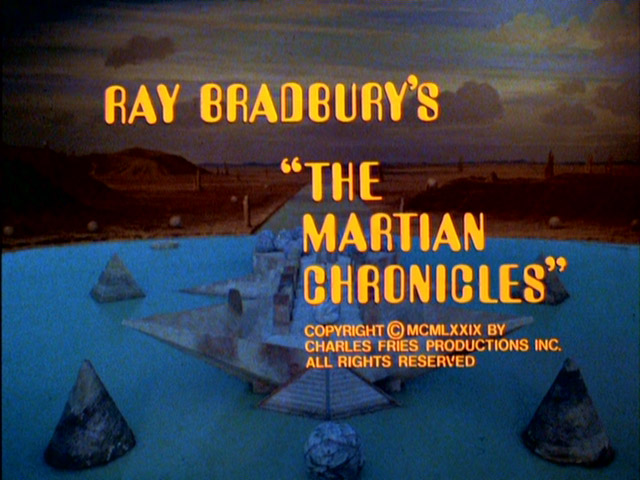
The Chronicles themselves only really achieved coherence when they were collected together out of the various magazines they’d been published into a single volume – with some slight amendments such as the inclusion of ‘interstitial vignettes’ to make them fit together. It was this volume that was adapted by NBC and the BBC in the late 70s and turned into the mini-series The Martian Chronicles.
Although the stories themselves had no central hero, since they take place over a number of decades, for the mini-series, rocket pilot Rock Hudson becomes the hero, replacing the heroes of the various short stories that had them.
Like the stories, The Martian Chronicles is a meandering affair, aimless, taking absurd detours because it’s really an umbrella for all of Bradbury’s short stories. So we have the central plot of the colonisation of Mars and how it’s taking on all the worst characteristics of Earth, including gambling.
Then there’ll be a brief interlude where Hudson finds out his old friend Barry Morse has replaced his entire family with identical robots – Barry then dies, leaving his robotic family to carry on without him, unaware they’re robots. Which makes sense as a short story about what it means to be human, the nature of family, etc, but is utterly incongruous when placed with all the others.
It’s no surprise that The Martian Chronicles failed both critically and in the ratings, particularly since Bradbury himself described it as ‘boring’ in a press conference to launch the mini-series. But it still was a poetical piece, in which the ultimate action adventurer, a space rocket pilot, learns that true happiness doesn’t come from technology and action – that’s the kind of thinking that ends up with the whole human race and planet Earth destroyed in a war – it comes from being happy with oneself and in what one does. It also had stunning designs that really conjured the idea of an alien race with its own aesthetic and view of the world.
The titles are anything but dynamic, but they are one of the few examples of a poetic title sequence you’re liable to find, attempting to demonstrate the beauty, peace and calm of these imaginary Martians who died, leaving only ideas behind.