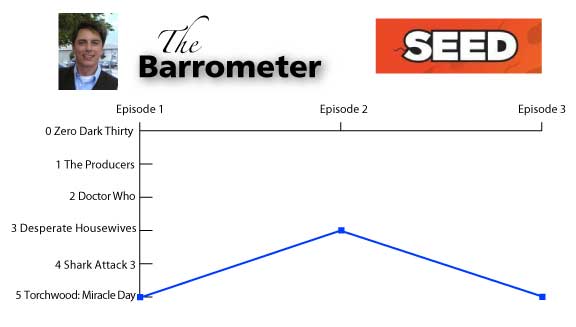
The BarrometerA Barrometer rating of 4

Third-episode verdict: Seed (CityTV)

In Canada: Mondays, 8:30pm ET/PT, CityTV
In the rest of the world: Not yet acquired

Well, I was patient. I was tempted to give up after the first episode of Seed, a Canadian comedy in which a Seth Rogen-esque slacker and sperm donor is tracked down by first his his biological son, then his biological daughter then one of his current, pregnant donation recipients (and new potential romantic partner), and has to come to terms with being a dad and offering sage life advice. It suffered from two basic flaws: relentless stereotyping and a lack of actual jokes.

Yet it was somehow so damn likeable that I stuck around for the second episode, which was a marked improvement: funnier, nicer and cleverer, and with fewer stereotypes. Could it be it was improving?

No. Mistake on my part, that. Episode three returned to the same lack of standards as episode 1, with more stereotypes than a Bernard Manning comedy routine and a matching lack of jokes.

Even on its own terms, it makes no sense whatsoever. Here’s a sample plot from the third episode: the lesbian couple with our ‘hero’s’ son have been trying to bring him up without any masculine attributes, such as ambition, assertiveness or aggression (which are just fine in them, mind you). However, ‘dad’ objects to his nine-year old going to ‘scrapbooking’ classes, and it turns out that the son is only going to the classes because of his mothers. So – because dad fancies the teacher – he enrols his son in a rhythmic gymnastics class instead. So what happens? The lesbians, who have been trying for nine years not to bring up their son in a stereotypical way, start to worry that their nine-year old needs to have more male interests or else he’ll turn out ‘super gay’.

What? You can try to make sense of that for the rest of eternity and it won’t.

So despite that strangely likeable quality, the complete lack of internal consistency, the rampant stereotyping and the total lack of jokes means it’s a big no to Seed from The Barrometer, I’m afraid.

Barrometer rating: 4
Rob’s prediction: Will last a season at best

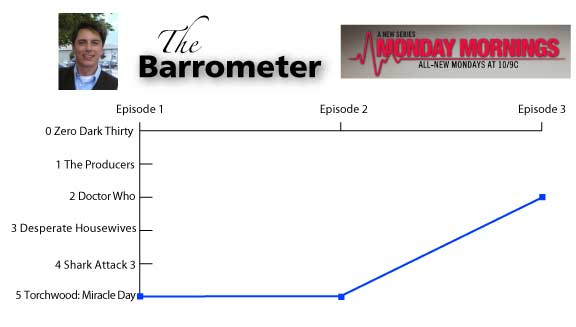
The BarrometerA Barrometer rating of 4

Third-episode verdict: Monday Mornings (TNT/Fox)

In the US: Mondays, 10/9c, TNT
In Canada: Mondays, 10pm ET, Bravo
In the UK: Acquired by Fox

As we’ve been (re)discovering recently, US TV pilots are never the finished products. Once a pilot becomes a series, plenty can change: problems can be sorted out, characters replaced or recast, and so on. The Following was the first of the recent mid-season shows to do a serious course-correction, and now we have a second: Monday Mornings, Ally McBeal creator and Wonder Woman ruiner David E Kelley’s attempt to diversify out of law shows and into medical shows.

The first episode was, of course, dire, full of mawkishness, ethnic stereotypes, lack of convincing characters, medical insanity and 20/20 hindsight, and some of the worst dialogue on TV since the last David E Kelley show, Harry’s Law (it’s since been surpassed by Zero Hour).

Worse still was the fundamental pillar of the show: the ‘Monday Morning’ fault check at ‘Chelsea Hospital’, where all the decisions made the doctors and surgeons are put under the microscope to see what mistakes have been made in an effort to prevent them happening again. Okay, so interesting to have a show that focuses on doctors cocking up rather than being heroic. But with Kelley in charge, the M&M becomes an almost literal courtroom, with chief surgeon and Brit Alfred Molina wearing a Doctor Octopus wig so that he can act as judge, jury and executioner to all those around him, while the doctors and surgeons also double up as juries, lawyers, defendants and prosecuting counsels. Rather than a learning experience that’s all about science and improving process, it’s a way to terrorise people, shout at them, and pass liberal judgement on them for not having hearts that bleed in precisely the right amount for precisely the right conditions and precisely the right patients, despite whatever statistics and probabilities would tell you.

The second episode was pretty much the same, in most regards, with the added ludicrousness of an in-story explanation of why Molina decides to shave his wig… sorry, hair off that’s even more mawkish than the saccharine dialogue. There was a little ambiguity in the ‘court scenes’, but it was pretty much a Xerox of the first episode in most regards.

So let’s all look a bit surprised with the third episode, which while not a total makeover, did change quite a bit of the show’s DNA. Sure, Ving Rhames still has almost nothing to do. Sure, Korean surgeon is largely there to be laughed at for being foreign and having an improbably poor standard of English and social skills. Sure, the female doctors talk about almost nothing about dating and relationships, while the male doctors talk about almost everything except dating and relationships. Sure, Jamie Bamber needs a haircut as much as Molina did.

But whether it was the addition of a co-writer to the story or whether it’s a sign of changes in the show, the third episode moved away from making Monday Mornings a show about doctors that mirrors legal dramas and made tentative steps towards making it a show about the intersection between the law and medicine. We had doctors being counselled in risk management techniques designed to reduce the chance of patients suing; we had an interesting philosophical debate about when a patient may (or may not) be able to give informed consent if they are mentally impaired, and how much work doctors should go to to find a proxy; we had a legal deposition on the lengths needed to ascertain whether someone is legally dead.

We also had a decent plot, with a man diagnosed with schizophrenia turning out to have a brain tumour; when it’s removed he reverts to the man he was back in 2006. In fact, he still thinks it is 2006. So again, we have a philosophical musing on whether it was right to take an otherwise happy but hallucinating man, and reveal to him that he’s lost seven years of his life, which has fallen apart in his absence.

The show obviously still has its problems: unlikeable and uninvolving characters; the siege-like Monday Morning sessions that are more about blame than learning and would have most surgeons running for the hills – or another hospital; the sexism, racism and xenophobia; a tendency towards the melodramatic, the forced, the implausible, the illogical, the unbearable and the pathetic; next-to-zero characterisation or background for anyone beyond how they do their jobs; a tenuous relationship with reality; and dialogue that’s got the safety catch off and is ready to kill.

But if it improves as much again in its next episode or at least goes in the same general direction, it’ll be well on its way towards carving out a new niche on TV and marrying two normally unrelated genres. Assuming that its ratings get better and it doesn’t get cancelled, anyway.

Barrometer rating: 4
Rob’s prediction: Will probably be cancelled at the end of the season

French TV

Review: Engrenages (Spiral) 4×3-4×4 (France: Canal+; UK: BBC Four)

In France: Last autumn
In the UK: Saturday 16 February, 9pm, BBC Four

Very much a game of two halves, this Saturday’s episodes. After I waxed lyrical about the show last week, episode three decided to be all contrary and a bit of a disappointment, an unremarkable plot expander, redeemed by just a few twists and turns.

But then episode four turned up. Episode four, which contained not just a big helping of WTF, but topped it all off with a massive dose of OMG. No, I don’t know what French texteese is for Oh My God. I’m assuming not OMD.

Continue reading “Review: Engrenages (Spiral) 4×3-4×4 (France: Canal+; UK: BBC Four)”

US TV

Review: Zero Hour 1×1 (ABC)

In the US: Thursdays, 8/7c, ABC

There are shows that despite essentially having an incredibly stupid premise actually turn out to be quite smart. Consider Prison Break, created by Paul Scheuring, in which an architect gets himself arrested so he can be incarcerated in the same prison as his death-row brother. Because he’s also the architect who designed the prison and has developed an intricate plan to get them both out of jail together – which he’s had tattooed onto his entire body.

Incredibly stupid premise, yet at times, it was actually quite smart, with intricate plotting, fun characters and tension aplenty.

Yet there are also shows that despite essentially having an incredibly stupid premise actually turn out to be absolutely stark staring bonkers insane.

Consider Zero Hour, created by – oh look – Paul Scheuring, in which Anthony Edwards’ wife gets abducted after she buys the wrong clock in a market. It turns out that it’s all part of a sinister conspiracy, involving the Rosicrucians, possibly the second coming or is it the anti-Christ, Nazis, reincarnation, 12 clocks, one for each of the apostles, and an unintelligible international terrorist. Only Edwards, together with a noble band of sceptical journalists, can save her and the world.

Yes, if you thought Dan Brown’s Da Vinci Code wasn’t far reaching enough in its implications and Angels and Demons was just too plausible, have I got a show for you… and it’s possibly the stupidest, worst written show since the dawn of time.

Here’s a trailer:

Continue reading “Review: Zero Hour 1×1 (ABC)”

Australian and New Zealand TV

Review: The Blue Rose 1×1-1×2 (TV3)

In New Zealand: Mondays, 8.30pm, TV3

New Zealand is a small country – okay, it’s quite big, but in turns of population, it’s quite small – but it does still have a surprisingly large effect on world media. The Lord of the Rings and The Hobbit were filmed there, mainly thanks to New Zealand film director Peter Jackson. The Oscar-winning Whale Rider launched the US career of actor Cliff Curtis (Trauma and Missing). A multitude of shows from the late 90s, including Hercules: The Legendary Journeys and Xena: Warrior Princess, introduced the likes of Lucy Lawless and Karl Urban to the world, and Spartacus is doing so with a new generation of actors all over again, with that show’s Manu Bennett leading the charge into the US.

However, New Zealand does have its own home-grown film and TV industry, and in modern times, three of the biggest forces in New Zealand TV have been broadcaster TV3, and James Griffin and Rachel Lang of South Pacific Pictures, the originators of the long-lasting Shortland Street. This combo first gave us the comedy crime series Outrageous Fortune (remade in the US as Scoundrels), which nurtured the career of many a New Zealand actor, including Anthony Starr, currently doing sterling work as the star of Cinemax’s Banshee.

Then came The Almighty Johnsons, which delved more into fantasy, with a tale of reincarnated Norse gods living in New Zealand. That’s currently filming its third season and a US remake is currently being piloted by SyFy. 

But it’s all systems go at South Pacific because now we have another Lang and Griffin project (actually, so far, it’s most Lang) – The Blue Rose, a comedy crime drama that reunites two of Outrageous Fortune‘s female stars, Antonia Prebble and Siobhan Marshall, in a tale of vigilantism and office temp work. When office temp Jane (Prebble) discovers that Rose, the PA she is replacing, died under mysterious circumstances, she joins forces with Rose’s best friend Linda (Marshall) to get justice for Rose. Along the way, they find others who need their help – victims of fraud, theft and injustice – and soon Jane, Linda and a team of unlikely co-workers are taking on the corporate bullies, fighting for justice and using their unique powers for good. They’re not afraid to break the law in order to stand up for the little people, and every step takes them a little closer to uncovering what really happened to Rose.

It’s an odd combination of office politics and murder mystery with a very odd couple at its heart, but it just about works. Here’s a trailer:

Continue reading “Review: The Blue Rose 1×1-1×2 (TV3)”