News: Donald Glover is young Lando; Netflix acquires Shooter; Sneakers TV series;

Film casting

Internet TV

New UK TV shows

  • Casting on BBC One’s Man In An Orange Shirt

US TV

New US TV shows

New US TV show casting

US TV

Review: Eyewitness 1×1 (US: USA)


In the US: Sundays, 10/9c, USA

Up until now, Norwegian TV hasn’t seemed to me to be a good birthing ground for new TV shows. Unlike Sweden and Denmark, which have done well in terms of adaptations with the likes of The Killing, Bron/Broen (The Bridge) and Den Som Dræber (Those Who Kill), Norwegian TV has stayed resolutely Norwegian. In part, maybe that’s because it’s not usually very good – at least, the likes of Okkupert (Occupied) and Mammon haven’t done anything to make me think there’s untapped potential there.

Yet here we are, staring down the barrel of the gun that is Eyewitness, an adaptation of NRK Norway’s Øyevitne (Eyewitness) by Shades of Blue creator Adi Hasak. Turns out there’s mileage in those fjords after all.

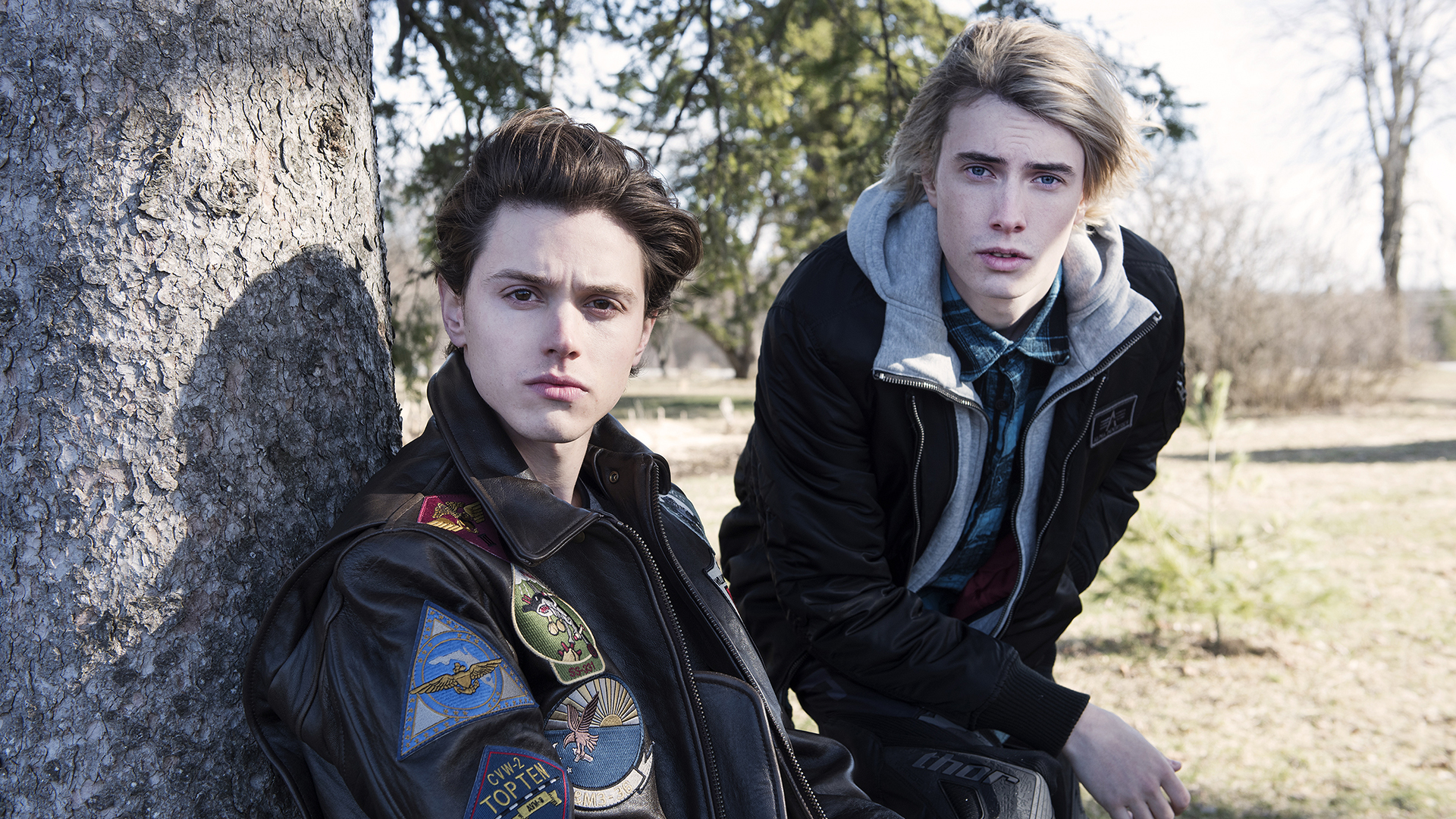
As with the original Norwegian series, Eyewitness is an anthology show and this first season sees two teenage boys (James Paxton and Tyler Young) out in the woods ostensibly racing motorbikes but both nursing a secret desire for the other. Just as they’re consumating their feelings for one another, a gang of criminals turns up with a captive in the boot of their car. However, an undercover FBI agent is in their ranks and before you know it, everyone but the boys is dead. 

The boys try to pretend nothing has happened, including their gayness, but the situation is complicated by the fact that Young is being fostered by local sheriff Julianne Nicholson (Law & Order: CI, Boardwalk Empire, Masters of Sex, Ally McBeal) and that FBI agent Tattiawna Jones might have bent a few rules as the handler of the deceased agent. Oh yes, and that not everyone died in the shoot out after all and the survivor has a fair idea of where the boys might be…

Anyone expecting either a new Fargo or a new Insomnia is going to be disappointed, as this is a pretty straight down the middle crime thriller bar the boys and the difficulties of being gay in a US High School, which make a welcome change from the usual plotting. However, disgraced city-detective Nicholson is the real focus of the piece, as she finds herself coming to life in her tedious upstate New York job now that real crime is occuring. This gives us the usual marital ructions, with Nicholson keeping numerous secrets from and failing to attend all sorts of important events with doctor hubbie Gil Bellows (Ally McBeal). There’s also the usual FBI mocking of ‘lesser’ agencies, usual ‘realistic’ look at drug addicts and usual gritty crime. 

In the hands of Twilight director Catherine Harwicke, it all looks great and it does have a slightly harder edge than might have been expected. Warren Christie (Alphas) makes a suitably silent but scary Terminator-like pursuer for the boys. But it you were looking for something new, some Norwegian-inspired Nordic Noir twist on the crime formula, as of yet, it hasn’t appeared. Or maybe it has and as I suspected, Norwegian TV doesn’t yet have much to offer the rest of the world.

Canadian TV

Review: Shoot The Messenger 1×1-1×2 (Canada: CBC)


In Canada: Mondays, 9pm (9.30pm NT), CBC

For ages, I was pining for a sequel to State of Play. I really was. It was just so bloody marvellous.

It didn’t help that the movie adaptation was just so average, I’m still only halfway through it.

State of Play 2 isn’t happening and never will. Sniff, boo hoo. So bless you Canada for trying to do your own (unofficial) State of Play. It’s not the same, it’s really not, but it touches me that you’d give it a go.

Shoot The Messenger has pretty much all the same plot threads as State of Play. It has street shootings. It has an intrepid reporter (Elyse Levesque from Stargate Universe) investigating a murder. It has an equally intreprid police department doing their own parallel investigation, with both sides feeding each other information to advance their own causes. The murder has political connections that might affect a certain big shot to whom Levesque has connections. It even has a plucky British newspaper editor (Alex “River Song” Kingston).

The big difference here is Levesque, who as well as being a cub reporter rather than a seasoned hack is also a bit of a shagger. She’s shagging the head of the police investigation (Lyriq Brent); she’s shagging her more experienced co-worker (Lucas Bryant). She also comes from a family of shaggers, since her sister is shagging said bigwig. And when Levesque isn’t shagging, she’s getting hit on the head or hiding under things. 

State of Play this is not. Sorry, Canada.

The show also lacks the journalistic verisimilitude of State of Play. While there are attempts to give both the police and newspaper sides of the plot a sheen of accuracy and Kingston’s frequent words of advice to Levesque are frequently useful, The Guardian-logo nicking, serious newspaper ‘The Gazette’ appears to be equipped with neither copy editors nor fact checkers, there don’t appear to be department heads, Levesque actually gets invited to the editor’s daily content meetings, there appears to be almost no appreciation of the existence of a little thing called the Internet or social media, Levesque thinks it’s okay to use a faux Google Images to check the spelling of names, and Kingston herself thinks it’s more grammatically correct to say ‘who is whom‘.

Oh dear.

State of Play comparisons to one side for a moment, Shoot The Messenger does at least do something different from the usual CBC drama, even the ones that are supposed to be thrilling (eg The Romeo Section, Cracked), by having some action and excitment – its plot focuses on the Somali community and local gang ‘the Mogadishu dogs’, with Levesque witnessing the murder of the brother of one of the gang members, which sets off a chain reaction of violence (and misreporting). But while there is the occasional insight into that community, mostly it’s all a lead in to corporate and political corruption and a Rob Ford analogy. 

But as a thriller, it’s not very thrilling and spends a lot of it’s time being apologetic for things and feeling sad about children getting killed in gang wars. There’s an unnecessary side plot about Levesque’s brain-damaged dad; with the exception of Brent, all the black characters are criminals or harbourers of criminals, leaving Bryant to be the implausible Somali expert at the paper; and Bryant seems like he’s on quaaludes the whole time.

Levesque and Kingston make Shoot The Messenger pass a lot more agreeably than it should. I might stick with it, since the political side of things hasn’t kicked in yet and it could well get better as a result. But more likely, I might just watch State of Play again.

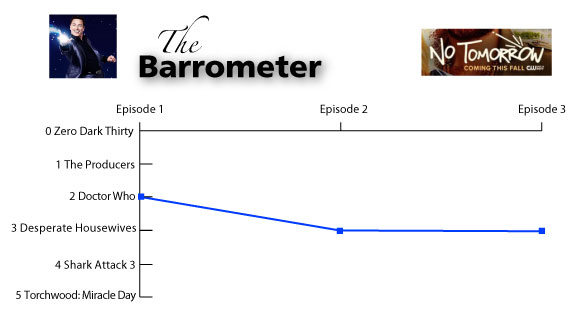
The BarrometerA Barrometer rating of 3

Third-episode verdict: No Tomorrow (US: The CW)

In the US: Tuesdays, 9/8c, The CW

“Who would you be with if you knew tomorrow was your last day on Earth?” is a common-enough “What if?” question. No one ever asks, “Who would you be with if you knew the next seven seasons were your last days on Earth?”

And that’s basically the issue with No Tomorrow, in which uptight American girl Tori Anderson falls in love at first sight with carefree non-American Joshua Sasse, who’s only as carefree as he is because he thinks the Earth is going to be hit by an asteroid in eight months’ time. Now, Anderson is delightful, Sasse is surprisingly unirritating, and the first episode was a lovely bit of joy, marrying heart and mind, in the middle of a pilot season full of stupidity and misery.

But they’re still here. They’re not going on a round the world cruise. They’re not canoeing up the Amazon. They’re not even robbing banks together.

They’re here. In Seattle still (I think). Anderson’s still stuck in her dead-end warehouse job, with her dead-end warehouse work colleagues. Sasse is still trying to convince the world an asteroid’s going to hit while romancing Anderson.

It’s the morning after the night before, basically. The honeymoon is over. The in-laws are here now and everything’s settling down.

Apart from Sasse’s accent. Sasse, a posh Brit whose accent landed somewhere in the mid-Atlantic in the first episode, has slowly been heading to other parts of the Commonwealth. By episode two he was about 30% Australian and by episode three he was about 50% Antipodean, sometimes Australian, sometimes a New Zealander. This is despite having a house covered in Union Jacks and dartboards.

Even the other characters are noticing it: “This British guy came in… or maybe he was Australian. I don’t know,” one said in episode two. Neither do I, cobber. Neither do I.

It doesn’t help that everyone has such atrocious bucket lists, too, with Anderson’s consisting of things like ‘put out a fire’. I guess if you only have a CW budget, that makes sense, but even for a character who’s supposed to be a bit timid, that’s poor.

Fortunately, bucket lists are only a minor part of the show and the b-plots at Anderson’s company and with her family are avoidable, even if they’re five steps away from shouting ‘O Captain, my Captain’ and standing on their desks at times. For the most part, instead, No Tomorrow remains a very, very odd couple romantic comedy, with Anderson and Sasse getting to know one another and bring the best out in each other. That still remains a little bit of joy each week in among the cynicism of the rest of 2016’s regularly scheduled programming.

No Tomorrow is a little bit too lightweight, divorced from reality and almost telenovela-like at times to be truly recommendable. But once you remove all the cruft from it and do your best to blank out whatever accent Sasse is trying to do, you’ll have a genuinely likable couple of leads in a genuinely lovely romantic comedy. That may not be enough to keep you watching, but it should warm you in the winter nights.

Barrometer rating: 3
Would it be better with a female lead? N/A
TMINE’s prediction: Will probably make it to a second season but I wouldn’t like to bet on it.

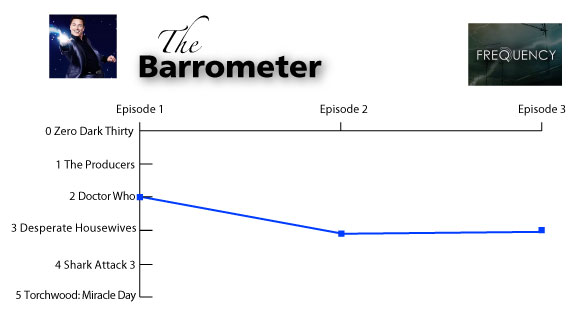
The BarrometerA Barrometer rating of 3

Third-episode verdict: Frequency (US: The CW; UK: Netflix)

In the US: Wednesdays, 9/8c, The CW
In the UK: Acquired by Netflix. New episodes on Thursdays

Following the first episode of Frequency, a gender-swapped, time-shortened adaptation of the movie of the same name in which police detective Peyton List discovers the old ham radio in her garage allows her to communicate with her cop father (Riley Smith) 20 years earlier before he was murdered, it was clear the show could have gone two ways. Way one was the more interesting. By passing information to the past but in ‘real time’, List can change her present, preventing things from happening or enabling others to occur, but only getting one shot at it – make a mistake and that’s that.

Of course, in that episode, List does make a big change in her past that could have been good but resulted in possibly even worse things happening instead. Frequency could then have been a show about what happens if you keep messing around with time. Okay, it’s been done in the movies with The Butterfly Effect, but I’m sure they could have had all manner of fun. 

Instead, Frequency went another direction, and in so doing became Minority Report, albeit a better Minority Report than the actual TV adaptation. As of episodes two and three, the show has become a cop show in which List knows what crimes are going to be committed and perhaps even by whom but can’t do anything about them since they happened 20 years earlier; however, she can pass the information back to her cop dad who can act on her information and stop crimes taking place before they occur – or at least make sure nothing worse happens or the bad guy gets away.

This isn’t as interesting but it’s still not bad. It also helps that List does at least have an unpredictable future ahead of her and even if her past is broken, she can still try to put right what now’s gone wrong herself with her fiancé (Daniel Bonjour), who doesn’t recognise her and thinks she’s stalking him.

All the same, what we now face is a weekly serial killer storyline which would be hackneyed enough if we didn’t have a time travelling Jack the Ripper to look forward to in Time After Time next year. There have been red herrings so obvious, they must have been left out in the noonday sun for a week before they turned and despite relationships and intimacy being one of the best things about the pilot episode, the show’s producers have put everyone at loggerheads with everyone else. 

Frequency is enjoyable enough, with a reasonably likable cast, but it’s not compulsory viewing. As a police procedural, it’s also a bit ropey, with List forced by the script to do all manner of cop things badly. Fortunately, the show has a flexible enough format that it can change storyline, characters or anything else at a moment’s notice, so definitely has the potential to become hugely more interesting without warning. But whether it will embrace this potential of science fiction or stick resolutely to police procedural remains to be seen.

Barrometer rating: 3
Would it be better with a female lead? N/A
TMINE’s prediction: Could go either way, depending on how prepared it is to ‘pivot’