Most TV critics are snooty people. I’m probably very snooty. You should shun me.
This snootiness can manifest in different ways. One of the more obvious is the ‘happiness hierarchy’ – miserable things are inherently ‘better’ than happy things, drama is superior to comedy and so on. It’s not that TV critics are universally Buddhists who think that all life is suffering, but there’s a certain belief that to be good, something needs to depict life as it is – and that’s miserable.
Naturally, when it comes to plays, the dramas resultingly get all the attention, particularly on TV. The usual litany of ‘top TV play series’ trotted out by a TV historian or enthusiast encompasses Play For Today, The Wednesday Play, Armchair Theatre and the like, perhaps focusing on Ken Loach’s work or something gritty about working class life in Hull, rather than Abigail’s Party, say, although that might get a look in because of what it says about suburban middle class concerns of the 70s. Not because it’s funny.
Meanwhile, perhaps the most successful play series of them all will barely pop up on their radar because it was chock full of comedies. Comedy Playhouse ran on BBC One for 15 series between 1961 and 1975, taking in 120 episodes along the way and including plays that would eventually give rise to no fewer than 27 spin-off TV series, including Steptoe and Son, Meet the Wife, Till Death Us Do Part, All Gas and Gaiters, Not in Front of the Children, Me Mammy, That’s Your Funeral, The Liver Birds, Are You Being Served? and Last of the SummerWine, as well as an additional spin-off series, Scottish Comedy Playhouse. Beat that Play For Today.
The series started when the head of BBC Light Entertainment, Tom Sloan, discovered Galton and Simpson were no longer writing for Tony Hancock and so asked them to do six one-off comedies with the hope that one might become established as a series. Galton and Simpson agreed, handing in six plays, the fourth of which, The Offer, went on to become Steptoe and Son. The series itself was successful enough that Galton and Simpson wrote a second series of six plays, after which subsequent series were written by different writers.
Up Pompeii! was the final play of the show’s eighth series, which had started with no less an entry than Carla Lane’s The Liver Birds. Its inspiration came during a trip abroad – Sloan and Michael Mills, the head of comedy at the BBC, were visiting the ruins of Pompeii. Mills had recently seen Frankie Howerd in the play A Funny Thing Happened on the Way to theForum, where he’d play the part of the slave Pseudolus (played by Zero Mostel in the movie):
He said to Sloan that he “half-expected Frankie Howerd to appear coming round some corner.” Sloan had replied “Why not?” and Up Pompeii! was born.
However, it was neither Sloan nor Mills who would write Up Pompeii! Instead, they asked Talbot Rothwell, the writer of no fewer than 19 Carry On! movies, to do the honours, and after sending set designer Sally Hulke to Pompeii to ensure some realism and authenticity in the production’s look, the play took flight.
Essentially just a vehicle for Frankie Howerd to deliver double entendres, usually to camera, against a backdrop of cod-Roman farcical shenanigans that owe more than a bit of inspiration to A Funny Thing Happened on the Way To The Forum, both Up Pompeii! and Up Pompeii! are nevertheless classics of comedy. The show would run for two series, and resulted in a movie sequel and two further movies and TV series with the same general format but set in different time periods, Up The Chastity Belt,Up The Front, Whoops Baghdad and Then Churchill Said to Me. There were also two follow-up specials, Further Up Pompeii, and a stage show.
Not bad, hey? But then even Comedy Playhouse returned in 2014, so clearly there’s a lot of it about. Titter ye not.
As you may have noticed from yesterday’s review, I really rather enjoyed Captain America: Civil War. In fact, I declared it the best MCU movie so far.
Of course, Captain America: Winter Soldier was my favourite before that, which set me thinking. Each Captain America movie has been better than its predecessor, which is almost unheard of in a trilogy. We can all think of a trilogy that has got worse with each new movie (eg The Matrix, Look Who’s Talking), that’s got better for its second outing before producing a disappointing conclusion (eg The Godfather, Star Wars, Star Trek)or that had worse sequel before improving for the final outing (eg Back To The Future, Ocean’s Eleven, Three Colours).
But I couldn’t think of any other trilogy where each new movie was better than the one before it. Can you?
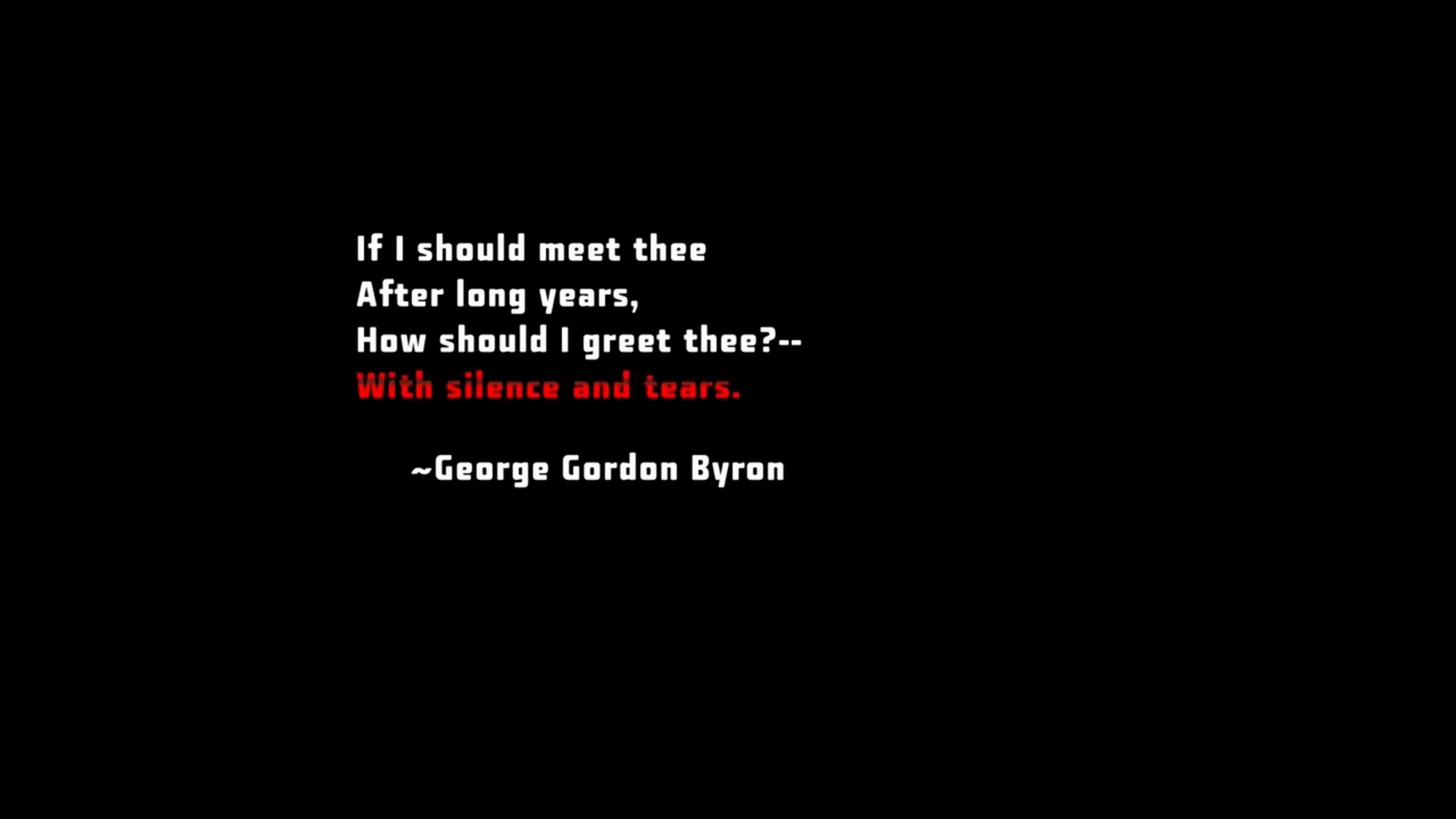
This week’s ‘Containment moment‘ is from (Lord) George Gordon Byron’s ‘When We Two Parted’.
Odd that a CW show should be so concerned about the alleged relationship between Lady Frances Webster and the Duke of Wellington. It’s almost like they simply picked something sophisticated-sounding at random that fit the plot.
When we two parted In silence and tears, Half broken-hearted To sever for years, Pale grew thy cheek and cold, Colder thy kiss; Truly that hour foretold Sorrow to this.
The dew of the morning Sunk chill on my brow — It felt like the warning Of what I feel now. Thy vows are all broken, And light is thy fame: I hear thy name spoken, And share in its shame.
They name thee before me, A knell to mine ear; A shudder comes o’er me — Why wert thou so dear? They know not I knew thee, Who knew thee too well: — Long, long shall I rue thee, Too deeply to tell.
In secret we met — In silence I grieve, That thy heart could forget, Thy spirit deceive. If I should meet thee After long years, How should I greet thee? — With silence and tears.