November at the BFI

Time for our regular look at what TV’s on at the South Bank in London in November. Quite a lot of tele this month as part of the Radical Television Drama season, but nothing else except for the Queen in 3D. Seriously.

  • 4th: The Wednesday Play: The Big Flame+ discussion with Tony Garnett 
    Docu-drama following striking dockers in Liverpool.
  • 4th: The Wednesday Play: Up the Junction + Diary of a Young Man (episode 1)
    Two Ken Loach films, one by Nell Dunn, one by Troy Kennedy Martin. 
  • 8th: The Wednesday Play: Vote, Vote, Vote for Nigel Barton + Play for Today: All Good Men
    Dennis Potter’s attack on the party political system, followed by Trevor Griffiths’s blistering polemic on the left/right struggle.
  • 12th: TV preview: The Queen in 3D
    Yes, 3D films of the Queen that will be part of Channel 4’s The Queen in 3D.
  • 13th: Scum + Q&A
    The famous play set in a borstal that launched Ray Winstone’s career. Q&A will include producer Margaret Matheson and writer Roy Minton.
  • 16th: Play for Today: Bloody Kids
    Stephen Poliakoff’s drama about a kid who fakes being stabbed in the chest
  • 18th: TV sold to the highest bidder – Thatcher’s television revolution
    Raymond Snoddy chairs a panel including Sir Michael Grade, Alasdair Milne, Tony Garnett and David Rose to examine the impact of Thatcherism on drama.
  • 18th: Play for Today: The Black Stuff
    The play that spawned Boys From The Black Stuff.
  • 19th: John Hill: from the The Big Flame to Leeds – United!
    How TV responded in drama to the industrial conflicts of the 60s and 70s.
  • 25th: Play for Today: Leeds – United! + Q&A
    The fight of women clothing workers in Leeds for better pay in 1970. Followed by Q&A with producer Kenith Trodd, writer Colin Welland and director Roy Battersby.
  • 26th: Oi for England + Made in Britain
    Neil Pearson in Trevor Griffiths’ play about the National Front, followed by Tim Roth as a disaffected skinhead.
  • 29th: Play for Today: United Kingdom + Q&A
    A left-wing council is removed from office after overspending. Directed by Roland Joffe. Q&A with producer Kenith Trodd.

Champions’ priority booking by phone: September 28
Members’ priority booking opens: 11.30am September 29
Public booking opens: 11.30am October 6

Prices
£7.60 (members)
£5.25 (member concs)
£9.00 (non-members)
£6.65 (non-members concs)
Under 16s £5.

All shows are £5 on Tuesdays. Conc prices are available to senior citizens, students, unwaged and disability visitors. Proof of eligibility may be required.

As always, visit the BFI web site for more details

Wednesday’s “suit, counter-suit” news

Doctor Who

Film

Music

British TV

US TV

Classic TV

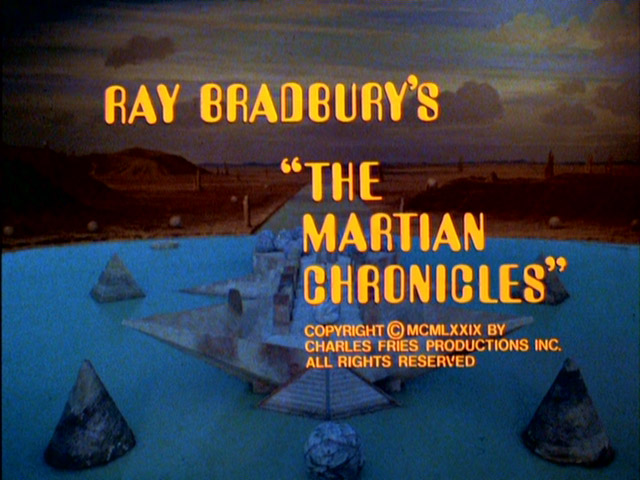
Weird old title sequences: The Martian Chronicles

Ray Bradbury was one of those science-fiction authors who didn’t like science. He didn’t like getting bogged down in all those nasty facts and things that made his ideas impossible, so he ignored most of science altogether.

Which for his Martian Chronicles was a good thing, I think. Okay, so it did mean that Mars mysteriously became a world with an oxygen atmosphere that human beings could just walk around on without difficulty. But Bradbury was able to let his flights of fancy soar without being tethered or bogged down by pedantic little details.

The Martian Chronicles is an impressive name for what is essentially a set of short stories, linked mainly by their setting, rather than any particular theme, world view or overall story arc. It details humanity’s various attempts during the 20th and 21st century to settle on the planet of Mars, where they encounter a society of telepathic and extremely alien Martians.

The Martians initially try to repel the new arrivals, but eventually they’re all but wiped out by diseases brought by humans to Mars. Eventually, the humans themselves are wiped out on Earth by nuclear war, and find themselves becoming the new Martians and adopting the Martian ways.

The Chronicles themselves only really achieved coherence when they were collected together out of the various magazines they’d been published into a single volume – with some slight amendments such as the inclusion of ‘interstitial vignettes’ to make them fit together. It was this volume that was adapted by NBC and the BBC in the late 70s and turned into the mini-series The Martian Chronicles.

Although the stories themselves had no central hero, since they take place over a number of decades, for the mini-series, rocket pilot Rock Hudson becomes the hero, replacing the heroes of the various short stories that had them.

Like the stories, The Martian Chronicles is a meandering affair, aimless, taking absurd detours because it’s really an umbrella for all of Bradbury’s short stories. So we have the central plot of the colonisation of Mars and how it’s taking on all the worst characteristics of Earth, including gambling.

Then there’ll be a brief interlude where Hudson finds out his old friend Barry Morse has replaced his entire family with identical robots – Barry then dies, leaving his robotic family to carry on without him, unaware they’re robots. Which makes sense as a short story about what it means to be human, the nature of family, etc, but is utterly incongruous when placed with all the others.

It’s no surprise that The Martian Chronicles failed both critically and in the ratings, particularly since Bradbury himself described it as ‘boring’ in a press conference to launch the mini-series. But it still was a poetical piece, in which the ultimate action adventurer, a space rocket pilot, learns that true happiness doesn’t come from technology and action – that’s the kind of thinking that ends up with the whole human race and planet Earth destroyed in a war – it comes from being happy with oneself and in what one does. It also had stunning designs that really conjured the idea of an alien race with its own aesthetic and view of the world.

The titles are anything but dynamic, but they are one of the few examples of a poetic title sequence you’re liable to find, attempting to demonstrate the beauty, peace and calm of these imaginary Martians who died, leaving only ideas behind.

Tuesday’s “bye bye suga” news

Doctor Who

Film

Music

Comics

British TV

US TV

US TV

Review: Community 1×1

Community

In the US: Thursdays, 9.30/8.30c, NBC

Smart comedies are hard to do. So hail to those who try their best to do smart comedies. Even bigger hails to those who manage to achieve it.

But sometimes you need to borrow an old formula to do it. There’s no shame in this if you can make it your own, though, which is what the creators of Community have done.

The name of that formula? Bill Murray.

Continue reading “Review: Community 1×1”