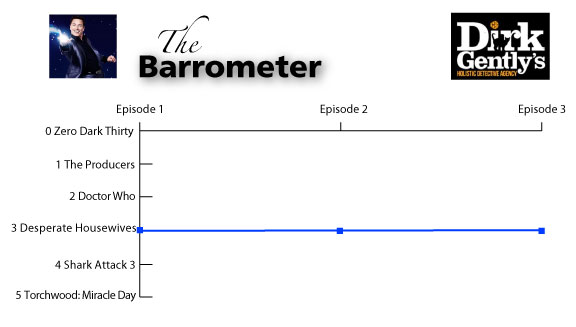
The BarrometerA Barrometer rating of 3

Third-episode verdict: Dirk Gently’s Holistic Detective Agency

In the US: Saturdays, 9/8c, BBC America
In the UK: Netflix. To be made available December 11

Dirk Gently is still odd. Dirk Gently? Only a little.

Following in the footsteps of BBC Four, BBC America’s adaptation of Douglas Adams’ Dirk Gently’s Holistic Detective Agency isn’t really an adaptation at all, more a continuation, in which Dirk is relocated to the US where he and hapless new sidekick Elijah Wood have to investigate the weird death of rich guy Julian McMahon, who’s killed in a hotel room by a shark – and who predicted he would be, months before his own death.

The first episode simply went from odd, inexplicable thing after odd, inexplicable thing, all seemingly unconnected, but in actuality laying out the clues that would all come together later on. Naturally, that’s meant the subsequent two episodes have both been about tying everything together and explaining what’s so important about a particular corgie, why there’s such a thing as a holistic assassin randomly murdering people and why a missing girl is holed up with Chief Tyrol from Battlestar Galactica. And by episode three it all seems to be coming together quite well – squint and you can see what’s going on – while still adding on the occasional new bit of odd.

Now, on the one hand, this is all divorced from the book(s), following none of their events. On the other, it’s got direct lifts from the books that have been altered to reflect more American concerns, with (third episode spoiler alert) time machines being built into basements of old houses rather than old Cambridge colleges, more familial elements, the CIA (of course) and – oh the horror! – an unnecessary origin story of sorts evolving for Dirk himself. 

What it definitely still is is bonkers, offering something that is as close to an American equivalent of a Douglas Adams story as I can remember. It’s not blessed by his genius when it comes to original ideas or comedy, but it comes reasonably close to a decent emulation and is actually pretty clever.

This new Dirk Gently’s Holistic Detective Agency isn’t must-see TV by a long-chalk and Samuel Barnett is only just about tolerable as this new incarnation of Dirk. But it’s better than the BBC Four version, closer in spirit to the books and is more imaginative. If you fancy believing six impossible things before breakfast, give it a whirl. 

Barrometer rating: 3
Would it be better with a female lead? Yes. Or Richard Schiff
TMINE’s prediction: Might well get a second season, but Netflix will get the final say.

News: Longmire, Workaholics cancelled; Josh renewed; Universal acquires Private Eyes; Pulling (US); + more

Film casting

Film trailers

  • New The Lego Batman Movie trailer

Internet TV

Israeli TV

UK TV

New UK TV shows

US TV

US TV show casting

New US TV shows

New US TV show casting

News: more Timeless; Kansas lesbians; Cormoran Strike casting; + more

The Daily News will return on Monday

Internet TV

  • Trailer for season 2 of Fuller House
  • Samm Levine and Marlo Thomas join Wet Hot American Summer: Ten Years Later

New UK TV show casting

US TV

US TV show casting

New US TV shows

US TV

Review: Pure Genius 1×1 (US: CBS; UK: Universal)


In the US: Thursdays, 10/9c, CBS 
In the UK: Wednesdays, 9pm, Universal. Starts 16th November

Healthcare research is an important topic. It is literally life-saving – or life-destroying if done wrong. It’s no surprise that billions of dollars are spent around the world to develop novel techniques and medicines, but always subject to strict ethical controls and procedures to ensure as few problems occur as possible.

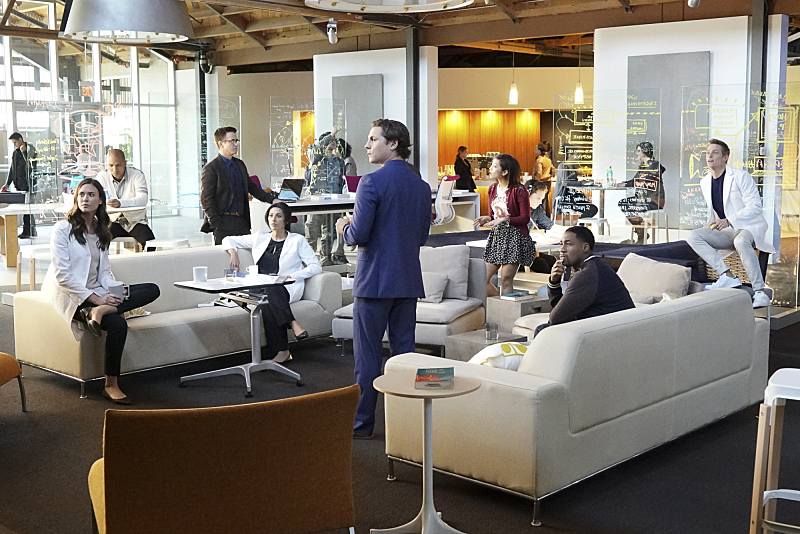
Of course, if you’re from a completely different industry sector, such as computing, this speed of innovation can seem problematic, and Pure Genius gives us the somewhat odd scenario of a Silicon Valley tech genius setting up his own hospital, packed full of top doctors, so they can try out cutting edge procedures – all with the bare minimum of ethical oversight. Of course, the rules are there for a reason, and the entire first episode is almost a cautionary tale of why those rules are there. Fancy giving someone an experimental ingestible piece of technology without a control group and while she’s pregnant? Let’s just see what happens when that goes wrong then…

Indeed, the show feels like someone recently went to a blue sky healthcare tech show, saw all manner of whizzy gadgets being simulated and tried to work out a TV show where all these things could be demonstrated in the (more or less) here and now, no matter how impossible it would be in practice unless every patient were a billionaire, too.

There’s certainly very little attention paid to any of the characters. We have a plethora of female doctors famous from other TV shows, including Royal Pains‘ Reshma Shetty and House‘s Odette Anable, picked because presumably it’s easier for us to assume they’re the same characters as before than to actually give them lives, proper histories, or relationships. Dermot Mulroney (Crisis) gets most of the attention, as a genius surgeon wondering if he should take a job in the hospital and then being persuaded by a 3D printer that prints out plastic hearts he can practise surgery on before dealing with the real thing – you can buy them down the shops now, Dermot, so don’t be so hasty.

But even Dermot is there just to show off the whizzy things. Likewise Augustus Prew (The Borgias), the show’s surprisingly stupid genius, who’ll Google something on the Internet that sounds like an epic white elephant (brain to brain communication technology) and buy the entire company for millions. He may be a bit poorly himself and have built the hospital largely to fund research that will save himself, but he’d really be more at home at Comdex 2016 on stage demonstrating a smartphone than talking to another human being about the prognosis following a radical but failed new course of treatment, which is where he starts to get a bit sad. Maybe you should have read up about double-blind treatments first, Augustus, hey?

By the end of the first episode, I’m surprised the whole bunch of them haven’t been sued and the hospital shut down due to serious malpractice, but given the levels of reality-warping needed for some of the things that take place to be realistic, I wouldn’t be surprised if the FDA is now a bowl of petunias and a very surprised sperm whale. 

Pure Genius? Pure nonsense more like it.

US TV

Review: The Great Indoors 1×1 (US: CBS; UK: ITV2)

In the US: Thursdays, 8.30/7.30c, CBS
In the UK: Acquired by ITV2

For those not in the know, CBS is a channel largely watched by older folk. The home of numerous procedurals and family sitcoms, it does, however, try to attract a younger audience from time to time, often with comedies such as The Big Bang Theory. And The Great Indoors is an interesting example of a comedy pitched at both the young and old – interesting in the sense that you can probably tell whether you’re young or old based on which characters you most empathise with.

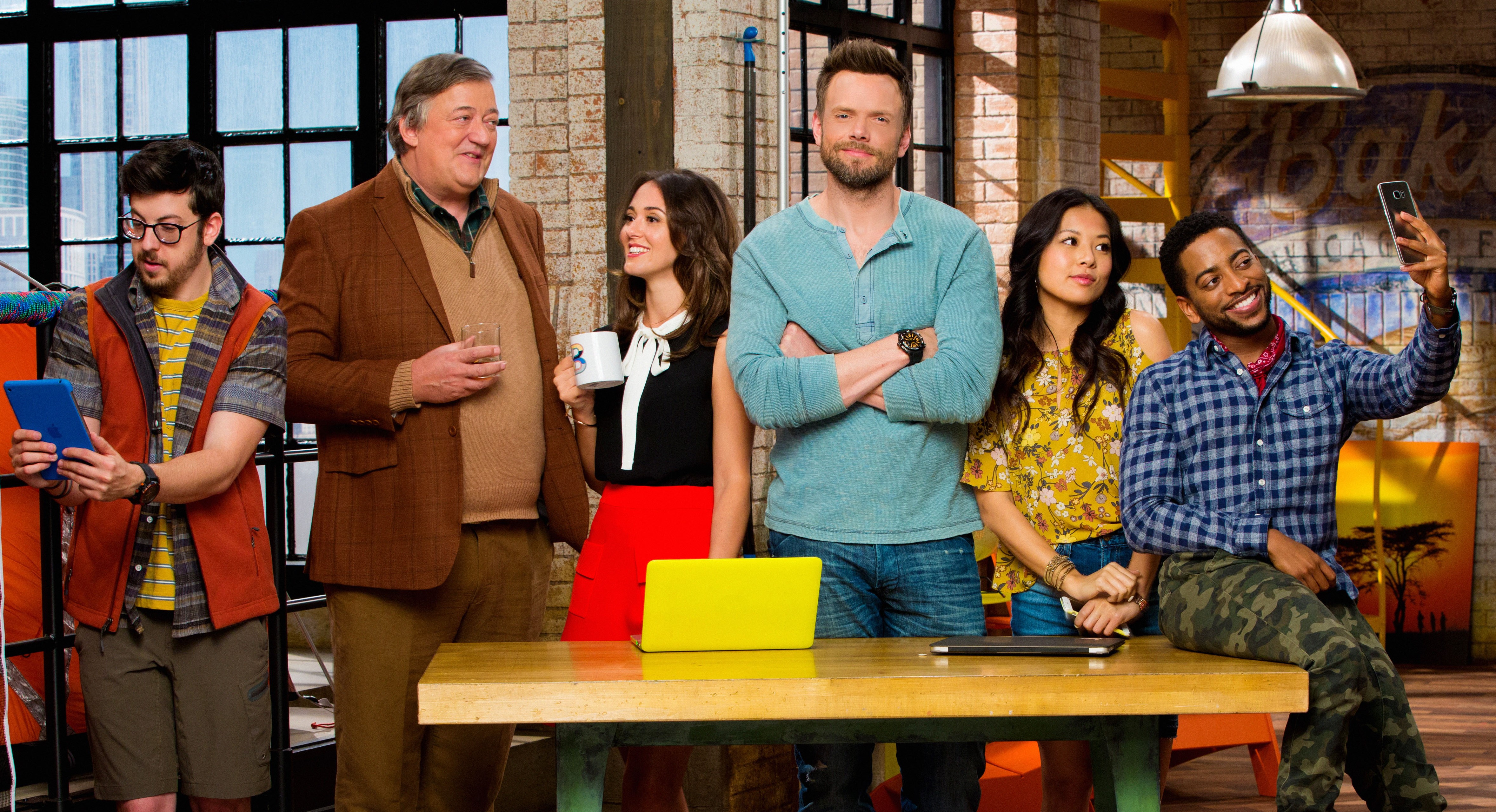
Community‘s Joel McHale (45) is a craggy magazine journalist, used to filing his copy from out in the field following close encounters with mountains, bears, Indian yogis and death. He’s summoned back to the office by proprietor Stephen Fry – yes, STEPHEN FRY (59) – where in common with untold numbers of other journalists around the world, he’s told the print version of the magazine is being shut but it’ll continue online. The slight hitch is that he’ll be office-bound and working with Christopher Mintz-Plasse (27), Shaun Brown (29) and Christine Ko (don’t ask) – the millennials that run the digital division of the company and whose idea of an experience is watching a YouTube video of an experience. Compounding the discomfort caused by his complete lack of experiental overlap with these mere foetuses is the fact that he’ll be working for Fry’s daughter, Susannah Fielding (31) (I Want My Wife Back, The C-Word), whom he probably slept with relatively recently, despite there being a slightly icky age gap.

Now, given it’s CBS – the home of cheap laughs at other people’s expenses, as well as of old people – you’d be forgiven for expecting The Great Indoors to be an excuse for the network to marry two disparate but related strands of humour: older, wiser people laughing at callow youth; and rugged manly types laughing at nerds. You’d also be forgiven for thinking that the show would know next to nothing about journalism or magazines, and that it would have the IQ and literacy of an angry letter to a local newspaper.

But, despite the trailer below suggesting just that, surprisingly The Great Indoors is more of a meeting of minds. While most laughs are at millennials’ behaviour, ranging from the speed at which they take offence at things through to their need to selfie their every waking moment, this is a meeting of minds in which McHale learns to be a better person and to understand online while the millennials learn how to put their smartphones down for a moment or two. Fry isn’t the usual stereotypical Englishman and his dialogue is often erudite and subversive. There’s even a suggestion that there has been some actual research done into magazine journalism, with job titles such as ‘digital curator’ and listicles about surviving the Zombie Apocalypse hinting that a day or two may have been spent at Buzzfeed at some point.

Of course, the show is creating a false dichotomy between the digeratti and the digital illiterate: I started working on newspaper web sites back in 1995 and any journalist my – and McHale’s – age will have been well acquainted with online publishing for years, if not decades. I’ve also seen that video featuring the bears in the swimming pool, too, and I have four Twitter accounts, a LinkedIn account and a Facebook account. Millennials working in journalism can still talk to sources and go outdoors; 40-somethings aren’t the same as 60-somethings. But, hey, it’s a multi-camera sitcom – you might as well critique mistakes in the maths in Big Bang Theory.

On the plus side, the pilot episode also features Stephen Fry nursing a bear cub and both McHale and Fry deliver the goods; on the minus side, the live studio audience seems to make Fielding think she’s in a pantomime and the millennials don’t really work as individual characters, rather than personifications of ideas of millennials.

If you like Fry and McHale, The Great Indoors might not wow you, but you certainly won’t come out of it feeling like you’ve been robbed of a great comedic opportunity. If you’re a millennial, you might not see yourself in the show, but what are you doing watching TV rather than Snapchats anyway?