The Weekly Play

The Wednesday Play: Penda’s Fen (1974)

Paganism, while not exactly featuring heavily in the more secular and Christian-influenced television drama schedules of Western societies, hasn’t been completely invisible over the past few decades. As we’re shortly to discover (ie either on Thursday or Friday when I write about it in much greater detail), British writers, particularly those who were working in the 70s, have occasionally taken time out to examine other religions in drama.

Despite coming from a family of strict evangelical Christians, one of the main writers to do so is David Rudkin. As well as translating Greek pagan works, such as those of Aeschylus and Euripides, Rudkin examined British paganism in plays and long-form series such as The Stone Dance, The Sons of Light and ultimately Artemis 81.

One of his major works was a Play For Today: Penda’s Fen. Directed by Alan Clarke, who normally was a strictly realist director and who admits he didn’t really understand it, the play is an evocation of the conflicting forces within England, both past and present. These include authority, tradition, hypocrisy, landscape, art, sexuality, and most of all, its mystical, ancient pagan past. In the play, all of this comes together in the growing pains of the adolescent Stephen, a vicar’s son, who encounters angels, Edward Elgar and King Penda, the last pagan king of England, during the play.

Since its broadcast, Penda’s Fen has gone on to be regarded as a minor classic. Leonard Buckley (no relation) of The Times wrote: “Make no mistake. We had a major work of television last night. Rudkin gave us something that had beauty, imagination and depth.” In 2006, Vertigo magazine described it as “One of the great visionary works of English film” while in 2011, it was chosen by Time Out London magazine as one of the 100 best British films, describing it as:

“A multi-layered reading of contemporary society and its personal, social, sexual, psychic and metaphysical fault lines. Fusing Elgar’s ‘Dream of Gerontius’ with a heightened socialism of vibrantly localist empathy, and pagan belief systems with pre-Norman histories and a seriously committed – and prescient – ecological awareness, ‘Penda’s Fen’ is a unique and important statement.”

And it’s your Wednesday Play – enjoy!

Further reading: Sparks in Electric Jelly

The Weekly Play

The Wednesday Play: Armchair Cinema – Regan (1974)

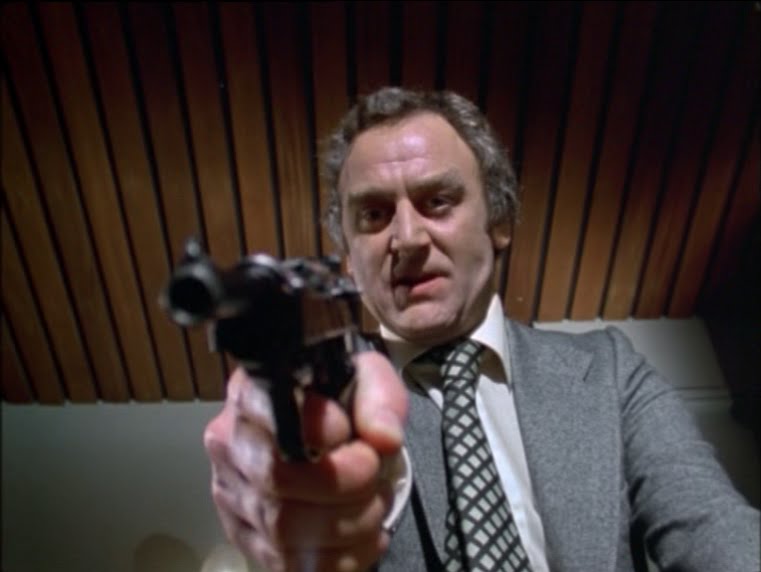
In the annals of British TV police series, few shows have been as influential or as important as The Sweeney. Starring John Thaw – the future Inspector Morse – as DI Jack Regan and Dennis Waterman – the future Minder – as DS George Carter of the Metropolitan Police’s ‘Flying Squad’, the show spawned imitators (Special Branch), homages (Life on Mars) and movies (The Sweeney), and even influenced the then-new Flying Squad themselves, showing them how to be the Flying Squad.

What’s not as well known is that The Sweeney actually started as one of Thames TV’s Armchair Cinema season, the continuation of ITV’s Armchair Theatre play series. It was written by Ian Kennedy Martin – the brother of Z-Cars (and The Italian Job and Edge of Darkness) writer Troy Kennedy Martin – with John Thaw in mind, Kennedy Martin having been script editor on 60s show Redcap, of which Thaw was the star.

Most of the essential elements of The Sweeney are here, so see below how the show started, in today’s Wednesday Play.

The Wednesday Play: Red Shift (1978)

Since I know a lot of you lovely readers are sci-fi lovers, today, I thought I’d give you the gift of one of the few sci-fi/fantasy plays that the BBC made in its standard drama strand, Play For Today. Based on Alan Garner’s novel of the same name, Red Shift is an odd little thing set in three time periods: Roman times, the Civil War and ‘modern times’. Linked by an artefact that appears in all three periods, a stone axe, the play looks at the plight of three different men, all faced with different challenges of the time, usually involving women. In the Roman period, some Roman deserters are in hiding, except the enemy may be within (or it might be the Celt woman they have prisoner, who might actually be a local goddess); in the Civil War, the goodies (including James Hazeldine) are holed up in a church, trying to escape from some Royalists; while in the present time, a somewhat pretentious student is vexed by his girlfriend and his parents.

To a certain extent, the story defies description, losing some aspects of the novel in translation to TV. The stories are linked more or less only by location, although the themes of adolescent angst, religion and control/lack of control of women are still there in the play. As a result, it’s more fascinating to watch mainly for the third story to see what ‘modern values’ were in 1978, with the pretentious student living with his parents in a caravan, and they being unwilling for him to have sex with his girlfriend. It’s also fun to see how little traffic there was in motorways in those days.

I won’t pretend it’s the greatest play ever and the specialised science-fiction strands at the BBC produced far superior work. But it’s a worth a watch out of historical curiosity and to see something that doesn’t give easy answers.

The Wednesday Play: Hedda Gabler (1972)

Hedda Gabler is generally considered one of the great dramatic roles in theatre. The heroine (of sorts) of Ibsen’s eponymous play, she is a woman who has recently married, not out of love but because she thinks her years of youthful abandon are over. Into her life comes the writer and her former lover Eilert Lovborg, who throws both her and her new husband’s life into disarray.

Since its 1890 publication, Hedda Gabler has been performed many, many times all over the world. Indeed, Sheridan Smith did a superb job back in September at the Old Vic last year. However, back in October 1972, it was Janet Suzman’s turn to play Gabler in Waris Hussein’s production for BBC Play of the Month. Co-staring (Sir) Ian McKellen has Gabler’s husband, Tom Bell as Lovborg and Jane Asher as Lovborg’s lover Thea Elvsted, it’s generally considered to be one of the best adaptions ever recorded, with Suzman more or less perfect as Gabler.

So enjoy!

BFI events

What TV’s on at the BFI in May 2013 + The Wednesday Play (on Thursday): The Spongers (1978)

Tony Garnett

It’s time for our regular look at the TV that the BFI is showing, this time in the month of May 2013. This month, as well as the continuing celebration of Doctor Who, which reaches the Peter Davison years with The Caves of Androzani

…there’s a Missing Believed Wiped special and the first half of a season of Tony Garnett’s work, that’s partly a Ken Loach season and which also includes Roland Joffé’s directorial debut, The Spongers, which I will arbitrarily declare this week’s Wednesday Play (on Thursday). Set during the 1977 Jubilee celebrations, Jim Allen’s script focuses on the plight of Pauline as she struggles to make ends meet. With a searing contemporary relevance, the film shows the human cost of decisions made by bureaucratic committees as council budgets are put under increasing pressure. Christine Hargreaves’ performance is devastating as we see the full impact of these decision on her children. One of the most important plays of the 70s, it still speaks loudly to our conscience today. Don’t forget to watch it at the BFI if you like it!

Continue reading “What TV’s on at the BFI in May 2013 + The Wednesday Play (on Thursday): The Spongers (1978)”