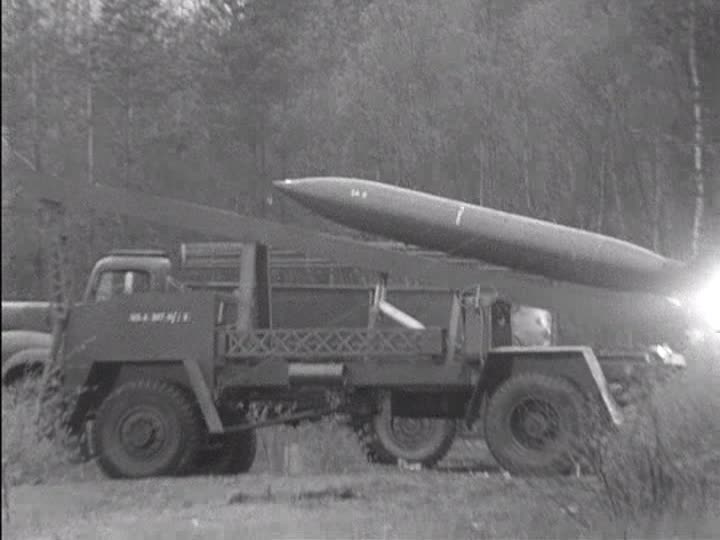
Last week, ‘Charley Says’ reminded us all just how scared sh*tless Britain was by the threat of nuclear war during the 1960s and 1970s – understandably perhaps, given the risk of destruction of the entire human race. Nevertheless, despite the release of Protect and Survive, not many people were optimistic about their chances come Armageddon.
In part, that’s thanks to the likes of this week’s Wednesday Play, The War Game, which was a genuine Wednesday Play from 1965. Written, directed and produced by Peter Watkins, this documentary-style production imagined what would happen if there was a limited nuclear strike against Britain. And it’s not pretty, with the instant blinding of those who see the explosion, a firestorm caused by the heat wave, radiation sickness, the British Army burning corpses and the police shooting looters during food riots.
Interspersed throughout the play are interviews with a series of establishment figures in favour of nuclear weapons and even nuclear war that were based on genuine quotations, as well as interviews with a doctor, a psychiatrist and others, giving details of the effects of nuclear weapons on the human body and mind.
Cheery, huh?
Well, no. In fact, following its transmission on 6 August 1965 (the 20th anniversary of the Hiroshima bombing), the BBC said that “the effect of the film has been judged by the BBC to be too horrifying for the medium of broadcasting” and withdrew it, never to air it in full until 1985. But, hey, lucky people, you can watch it now! Remember – if you like it, buy it.
12% of those polled believe the success of actor David Hasselhoff, star of Baywatch, is due at least in part to “dealings with the devil”.
These days, Michael Moore is best known as a film-maker. Indeed, that’s where he started with Roger and Me, a documentary in which he charted what happened in his hometown of Flint, Michigan, after General Motors closed its factories and moved to Mexico (‘Roger’ being Roger B Smith, the then-CEO of General Motors). Since then he’s gone on to make Fahrenheit 9/11, Bowling for Columbine and Sicko and other notable polemics that have looked at everything from gun control to the US healthcare system.
16% of Perot voters believe “if dolphins were really smart, they could get out of those nets”.
However, following the success of Roger & Me, Warner Bros contacted Moore about making a television series. After a long and circuitous route, Moore and his wife, TV producer Kathleen Glynn, came up with the idea of a humorous magazine show with a point of view. TV Nation was born.
NBC gave the go-ahead for a pilot for TV Nation in 1993 but soon discovered it didn’t have room in the schedule for the show. But, strangely enough, the head of BBC2 heard about the pilot, saw it and offered to buy the show. This spurred NBC into adding the show to its summer line-up.
39% of Americans believe that guns are not “as dangerous as they say”.
TV Nation was, as that initial idea and its pedigree suggested, a different kind of beast. Like 60 Minutes, the show had a number of correspondents – including Janeane Garofalo and Louis Theroux, who adopted a style of reporting much like Moore’s and which he’s been using ever since – reporting on issues while Moore (who himself did some stories) anchored the show and introduced each segment.
But the show had attitude. The kinds of stories chosen varied between the political to the consumer to the attitudinal. A correspondent might go undercover in shops to see if he could buy ‘small-sized’ condoms – and to see what the reaction was when he asked for them (laughter, frequently. And apparently you can buy them – they’re called ‘snug fit’). Or he might try to smuggle himself across the border… from Canada, only to discover that no one cared about illegal Canadian immigrants. Or perhaps an actor might move into a neighbourhood and behave in a ‘serial killer’ like way. On one occasion, the show hired a lobbyist for $5,000 in an effort to get Congress to declare a ‘TV Nation Day’ (it did).
And there was also Crackers, the ‘Corporate-Crime-fighting chicken’, who travelled the US highlighting incidents of corporate crime. Fondly remembered as well were the results of genuine opinion polls conducted for the show that highlighted both the silliness of opinion polls, as well as potentially worrying opinions among the US public.
12.5% of Americans that voted for Clinton believe that they will someday be told “just what Victoria’s Secret is”. 98% of Bush voters believe they will never know.
The BBC2 funding for the show ensured that not all investigations were American, however. As well as an investigation of the ‘naughty schoolgirl spanking and canning’ market for older men, the show featured segments on topics such as the TV licence, showing how Britons could be sent for prison for not paying the mandatory TV licence/tax.
37% of Americans agree that while they would hate being British, they wouldn’t mind having a British accent.
NBC cancelled the show after the first season, but surprisingly Fox picked it up for a second season in 1995. And then cancelled it, despite getting more letters than they had ever had for any other show before. Nevertheless, by 1997, the BBC had raised all the money necessary for a third season. Unfortunately, without a US network willing to air it, the third season never happened, instead transforming into a Channel 4 show The Awful Truth, which carried on in much the same way.
You can’t buy TV Nation on DVD, I’m afraid, but you can get The Awful Truth. Happily, you can watch clips from both below, including Louis Theroux’s happy little chat with a member of the Ku Klux Klan as he tries to give them a PR make-over.
Although most of the public information films of the 1970s were largely concerned with everyday dangers, such as rabies, water, fridges and electricity sub-stations, there was one every-present concern that trumped all of these: the end of the world. The end of the world and general apocalypse was something that dominated the thinking of people in everyday life and in movies and TV – look at the popularity of Soylent Green, The Omega Man, Logan’s Run, Survivors, et al. Why? Because the world really did seem doomed, thanks to the Cold War and nuclear weapons.
Here in the UK, if the USSR had launched nuclear weapons at us, we’d have had precisely four minutes’ notice before the warheads exploded over our cities. Warnings would have sounded and we’d have had just those few short minutes to prepare ourselves for the end of civilisation as we knew it – assuming we survived, of course.
Fortunately, there was a public information booklet, radio series and accompanying films to explain how we could maximise our chances of survival in the event of Armageddon. The infamous Protect and Survive incorporated all manner of useful information for British citizens, such as how to dismantle doors to create a make-shift fallout shelter. Assuming, of course, you didn’t have a ‘fallout room’ in your house.
Watch these films to learn more on how to protect yourself in the event of the prospective annihilation of the human race, including how to build a fallout room, what to put in it and what to do with casualties and the dead after the attack. Remember – never keep a dead body in the house for more than five days.
It’s tempting, these days, just as the likes of Agents of SHIELD, Hannibal and Bates Motel are gracing our screens (or about to), to think that the idea of spinning off a TV series from a popular movie is a new phenomenon. But just as the likes of Dick Barton and Bernard Quatermass were moving from radio and the small screen to the big screen in the 40s and 50s, so, too, were popular movie characters making the transition to TV.
So after the jump, let’s talk about Harry Lime aka The Third Man.