The Wednesday Plays: Alfred Hitchcock Presents – Man From The South (1960) and Diamonds Aren’t Forever (1989)

While The Twilight Zone and The Outer Limits remain the most well known of America’s anthology series, there remains one significant non-genre anthology show that in some ways, embodies the classic common notion of The Twilight Zone – a story with a twist in the tail – better than The Twilight Zone did.

Alfred Hitchcock Presents, hosted by the eponymous film director, originally ran for seven seasons, first on CBS from 1955 to 1960 as half-hour episodes, and then on NBC between 1960 and 1962, followed by The Alfred Hitchcock Hour, which lasted for a further three seasons. Each started with an introduction by Alfred Hitchcock himself and ended with a follow-up sketch. Intriguingly, these varied depending on what country you saw them in – in the US, they frequently mocked the sponsors and popular commercials, while in Europe (with Hitchcock speaking fluently in French or German as the need demanded), they usually mocked Americans.

In between these Hitchcockians bookends were stories, occasionally directed by Hitchcock himself, that were dramas, thrillers and mysteries that almost always ended with a surprise twist – far more than Twilight Zone episodes did, certainly. Only once did the director himself appear in the main story, but a list of all the notable actors that did appear in the show would be vast.

A list of all the talented writers who wrote for the show would be equally long, but possibly the best and the most famous episode of the entire run was the Man From The South, featuring Steve McQueen and Peter Lorre. That was written by no less than Roald Dahl, who went on to give us his own version of the show as Tales of the Unexpected.

As always, if you liked it, buy it on DVD!

So popular was Alfred Hitchcock Presents in syndication that it was revived in the 1980s, following the success of a TV anthology movie similar to the cinematically released 1983 movie The Twilight Zone: The Movie. Hitchcock obviously couldn’t do any new introductions, so colourised introductions from the original series were used instead.

The New Alfred Hitchcock Presents ran on NBC from 1985 to 1986 and was revived on NBC’s sister channel the USA Network from 1987 to 1989. This had a greater tendency towards the comedic and went far and wide for material, even taking in a Sherlock Holmes mystery along the way. It was successful enough to encourage The Twilight Zone to be revived in the same way, although these lacked Rod Serling in any form beyond a brief smokey appearance in the main titles.

Possibly the most timely, if not the best, is this 1989 effort, Diamonds Aren’t Forever, which starred George Lazenby as definitely not James Bond. Definitely not.

Enjoy (and say thank you to Toby for suggesting it)!

The Weekly Play

The Wednesday Play: The Night Gallery – They’re Tearing Down Tom Riley’s Bar (1971)

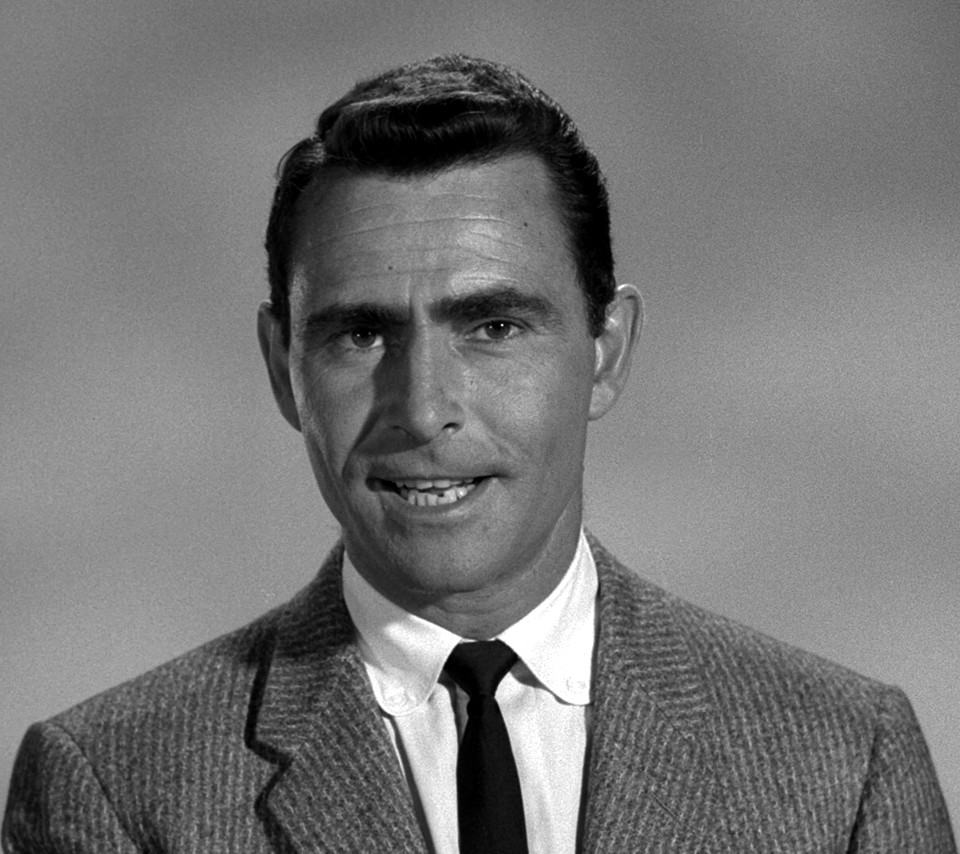
In a different age, Rod Serling would have become one of America’s most famous popular playwrights. Instead, Serling is best known as the man who did the introduction to every episode of The Twilight Zone. Where’s the justice in that?

Serling wasn’t just the narrator of The Twilight Zone – he was its creator and wrote many of its most famous episodes. He was also the man who turned French author Pierre Boulle’s satirical novel La planète des singes into the sci-fi film classic The Planet of the Apes

After The Twilight Zone ended, he went on to create and introduce the similar anthology series Night Gallery. This aired from 1970 to 1973 on NBC in the US and was initially part of wheel series Four In One, which included McCloud, SFX and The Psychiatrist. Each week, Night Gallery presented an individual fantasy play, usually original, sometimes an adaption of a classic story by a famous author such as HP Lovecraft. The tales were usually macabre, usually written by Serling and always featured a painting and Serling in its introduction.

While few of the episodes achieved the ‘classic’ status of some of The Twilight Zone‘s, there were some notable Night Gallery plays. They’re Tearing Down Tom Riley’s Bar was considered by Serling one of his two greatest works and was nominated for the Emmy for Outstanding Single Program on US television in 1971.

In this tale of ‘paint, pigment and desperation’, former WW2 paratrooper Randolph Lane (William Windom) has spent the previous 25 years selling plastics and not feeling particularly special. His company doesn’t value him, he has to fight every young upstart on the way up, and then there’s the guilt: his wife Katie died years ago of pneumonia and he wasn’t there to help her or take her to hospital.

And now, 25 years to the day that he started work Pritkin’s Plastic Products, he gets fired without even a gold watch for compensation. Worse, a company is getting ready to destroy his favorite drinking spot, Tim Riley’s Bar – the very place where Randy’s homecoming from Europe was celebrated, where his Dad sang ‘It’s a Long Way to Tipperary’ to him, and where Katie and he used to go together and gaze into each other’s eyes.

But in true Serling style, this is no ordinary play and there are ghosts. All the same, there are no scares, nothing truly supernatural, only the horror of the passage of time and the inevitable sense of aging too quickly. It is about, as Serling says in his opening narration, “the quiet desperation of men over 40 who keep hearing heavy footsteps behind them and are torn between a fear and compulsion to look over their shoulders.”

I would say enjoy – but prepare to be moved, at the very least, by one of America’s best writers – in any medium.

The Wednesday Play: Edna The Inebriate Woman (1971)

Back to social realism again. Except not.

1966’s Cathy Come Home was perhaps the most influential play on British television. Dealing with homelessness, its director Ken Loach used documentary techniques to give the play a heightened sense of realism, to make the plight of the homeless involved less artificial.

But in 1971, Edna The Inebriate Woman went in the opposite direction. Also written by Jeremy Sanford, who himself lived as a homeless person to research the play, it stars Patricia Hayes from the Benny Hill Show as the eponymous Edna – although given she uses so many false names in the play, maybe that’s not her name either. In it, the Chaplin-like Edna tramps streets and lanes looking for a home. She goes through lodging houses, psychiatric hospitals, Holloway prison, derelict barns and refuges, bounced around by the social services and the police and the unwanted attentions of other tramps. Only a hostel run by the idealistic Josie (Barbara Jefford), is welcoming.

The Inebriate Woman differs from Cathy Come Home not least in its lush colour photography but also in its writing style: much like the inebriated Edna, the story is fragmented, with scenes interrupting each other, and there’s also comedy interspersed with the moments of misery. All the same, this is a powerful play about the misery of homelessness.

Enjoy!

The Wednesday Plays: To Lay A Ghost/The Man In My Head (1971)

Over the years, US TV has had numerous famous science-fiction and fantasy ‘anthology’ series: The Twilight Zone, The Outer Limits, and The Night Gallery to name but a few. In the UK, we’ve been far less lucky. But we’ve had a few, the classiest and most sophisticated of which was Out of the Unknown, which I’ve already discussed a bit back in Weird Old Title Sequences (go and watch The Machine Stops – it’s great).

Initially, under the oversight of Irene Shubik, Out of the Unknown covered purely science-fiction concepts and adaptations. However, by the third and fourth series, a new production team was put in place, following Shubik’s departure from the programme. New producer Alan Bromly decided that in light of the Apollo missions, people weren’t impressed by space travel any more, so decided to go for more psychological horror stories instead – with mixed success.

Possibly the worst of his run was To Lay A Ghost. In this, Eric and Diana Carver move into a new home in the country, but a series of strange events soon cause Diana to suspect the house is haunted by the ghost of a man who seems to be interested in her particularly. She was sexually assaulted when she was a schoolgirl and ever since has had a complex about sex and intimacy. When they call in Dr Philmore, a paranormal expert, he suspects that Diana subconsciously wants to the dominated by this supernatural intruder.

To Lay A Ghost unfortunately still exists in the BBC archives – yes, from the same season, the BBC wiped Nigel Kneale’s one contribution to Out of the Unknown, Chopper, but decided to keep the “woman raped while a child can now only achieve sexual satisfaction by being raped” story. FFS. Watch it if you dare:

However, I wouldn’t leave you only with that ‘horror story’ to watch this week. Have more faith.

Instead, let me leave you with possibly the best remaining play of the fourth series (and possibly of all the fourth series), The Man In My Head, by John Wiles. Set in the near future, it features a group of soldiers who are carrying out a dangerous mission against a country they are not even sure they are at war with. Their briefing has been imprinted on their subconsciousnesses and can only be triggered by coded radio signals.

Acting automatically and without thinking, some of them begin to question the nature of their mission, especially after one of them accidentally triggers his own cover story, which was designed to fool interrogators if they were captured. But is their dissent all part of their programming as well?

The play features some dodgy CSO effects, but it’s well directed by Peter “I cancelled Doctor Who, I did” Cregeen who intriguingly makes use in the play of real news footage of the Vietnam war – something that got Doomwatch‘s Sex and Violence banned in 1972. Enjoy!

The Weekly Play

The Wednesday Play: Romeo and Juliet (1978)

Sir John Gielgud in Romeo & Juliet

Since we were talking about youthful suicide pacts very recently, it seems appropriate that this week’s Wednesday Play should be the 1978 BBC production of Romeo & Juliet.

Although it might be tempting to be incredibly awe-struck by the ambition of the BBC’s recent The Hollow Crown season, which this year adapted four of Shakespeare’s history plays – Richard II, Henry IV parts 1 & 2 and Henry V – step back in amazement at the ambition that was the BBC’s seven year-long Television Shakespeare project between 1978 and 1985: a series of adaptations, staged specifically for television, of all 36 First Folio plays, as well as Pericles (but not The Two Noble Kinsmen and Edward III).

Co-productions with the US Time-Life Television, controversially, the plays were originally planned to be staged conventionally in Shakespearean costumes and sets, and to be abridged to fit an allotted length of two and a half hours. However, when it was realised that that would kill most of the tragedies stone dead, the time limit was lifted, even if all the other restrictions were left in place – something that resulted in director Michael Bogdanov resigning from his modern-dress interpretation of Timon of Athens (Jonathan Miller replaced him) when it failed to be appreciated by Time-Life.

The result was a slight reputation of the series being staid and dull productions of the texts. Nevertheless, the project did have virtues, in some cases producing the only ever televised versions of some of Shakespeare’s more obscure plays, such as The Life and Death of King John, which starred Leonard Rossiter in his last screen role. Other notable and surprising actors to appear in the series included Roger Daltrey, Derek Jacobi as Hamlet, Anthony Quayle as Falstaff, Anthony Hopkins as Othello (no really), Bob Hoskins, John Cleese as Petruchio in The Taming of the Shrew, Donald Sinden, Alan Howard as Coriolanus, Laurence Olivier, Brenda Blethyn, Jonathan Pryce, Felicity Kendall, Diana Rigg, John Hurt, Bernard Hill, Zoe Wanamaker and Robert Lindsay.

The plays quickly found love in schools, thanks to the arrival of VHS recorders, and although the BBC only made them available as a set on VHS, they eventually became available individually as well as a collection on DVD.

The 1978 production of Romeo & Juliet, directed by Alvin Rakoff, was the very first of the adaptations. It sees Patrick Ryecart and Rebecca Saire as the star-crossed lovers, and also features Celia Johnson, Michael Hordern, John Gielgud, Anthony Andrews, Alan Rickman, Jacqueline Hill and Christopher Strauli to name but a few. If you like it, as always, buy it on DVD to support those nice BBC people who made it. Enjoy!

Continue reading “The Wednesday Play: Romeo and Juliet (1978)”