Remember Ghostwatch? If not, I wrote about it here. Remember how I mentioned that there was a documentary being made about it? Well, looks like it’s nearly finished.
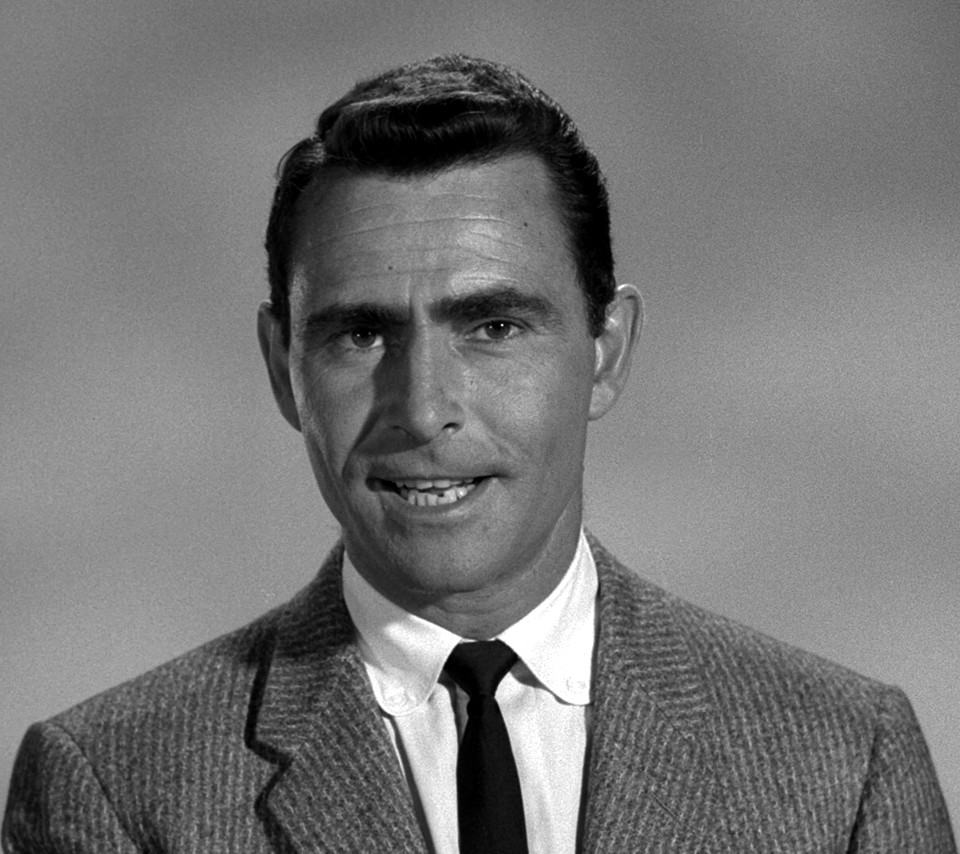
In a different age, Rod Serling would have become one of America’s most famous popular playwrights. Instead, Serling is best known as the man who did the introduction to every episode of The Twilight Zone. Where’s the justice in that?
Serling wasn’t just the narrator of The Twilight Zone – he was its creator and wrote many of its most famous episodes. He was also the man who turned French author Pierre Boulle’s satirical novel La planète des singes into the sci-fi film classic The Planet of the Apes.
After The Twilight Zone ended, he went on to create and introduce the similar anthology series Night Gallery. This aired from 1970 to 1973 on NBC in the US and was initially part of wheel seriesFour In One, which included McCloud, SFX and The Psychiatrist. Each week, Night Gallery presented an individual fantasy play, usually original, sometimes an adaption of a classic story by a famous author such as HP Lovecraft. The tales were usually macabre, usually written by Serling and always featured a painting and Serling in its introduction.
While few of the episodes achieved the ‘classic’ status of some of The Twilight Zone‘s, there were some notable Night Gallery plays. They’re Tearing Down Tom Riley’s Bar was considered by Serling one of his two greatest works and was nominated for the Emmy for Outstanding Single Program on US television in 1971.
In this tale of ‘paint, pigment and desperation’, former WW2 paratrooper Randolph Lane (William Windom) has spent the previous 25 years selling plastics and not feeling particularly special. His company doesn’t value him, he has to fight every young upstart on the way up, and then there’s the guilt: his wife Katie died years ago of pneumonia and he wasn’t there to help her or take her to hospital.
And now, 25 years to the day that he started work Pritkin’s Plastic Products, he gets fired without even a gold watch for compensation. Worse, a company is getting ready to destroy his favorite drinking spot, Tim Riley’s Bar – the very place where Randy’s homecoming from Europe was celebrated, where his Dad sang ‘It’s a Long Way to Tipperary’ to him, and where Katie and he used to go together and gaze into each other’s eyes.
But in true Serling style, this is no ordinary play and there are ghosts. All the same, there are no scares, nothing truly supernatural, only the horror of the passage of time and the inevitable sense of aging too quickly. It is about, as Serling says in his opening narration, “the quiet desperation of men over 40 who keep hearing heavy footsteps behind them and are torn between a fear and compulsion to look over their shoulders.”
I would say enjoy – but prepare to be moved, at the very least, by one of America’s best writers – in any medium.
1966’s Cathy Come Home was perhaps the most influential play on British television. Dealing with homelessness, its director Ken Loach used documentary techniques to give the play a heightened sense of realism, to make the plight of the homeless involved less artificial.
But in 1971, Edna The Inebriate Woman went in the opposite direction. Also written by Jeremy Sanford, who himself lived as a homeless person to research the play, it stars Patricia Hayes from the Benny Hill Show as the eponymous Edna – although given she uses so many false names in the play, maybe that’s not her name either. In it, the Chaplin-like Edna tramps streets and lanes looking for a home. She goes through lodging houses, psychiatric hospitals, Holloway prison, derelict barns and refuges, bounced around by the social services and the police and the unwanted attentions of other tramps. Only a hostel run by the idealistic Josie (Barbara Jefford), is welcoming.
The Inebriate Woman differs from Cathy Come Home not least in its lush colour photography but also in its writing style: much like the inebriated Edna, the story is fragmented, with scenes interrupting each other, and there’s also comedy interspersed with the moments of misery. All the same, this is a powerful play about the misery of homelessness.
Over the years, US TV has had numerous famous science-fiction and fantasy ‘anthology’ series: The Twilight Zone, The Outer Limits, and The Night Gallery to name but a few. In the UK, we’ve been far less lucky. But we’ve had a few, the classiest and most sophisticated of which was Out of the Unknown, which I’ve already discussed a bit back in Weird Old Title Sequences (go and watch The Machine Stops – it’s great).
Initially, under the oversight of Irene Shubik, Out of the Unknown covered purely science-fiction concepts and adaptations. However, by the third and fourth series, a new production team was put in place, following Shubik’s departure from the programme. New producer Alan Bromly decided that in light of the Apollo missions, people weren’t impressed by space travel any more, so decided to go for more psychological horror stories instead – with mixed success.
Possibly the worst of his run was To Lay A Ghost. In this, Eric and Diana Carver move into a new home in the country, but a series of strange events soon cause Diana to suspect the house is haunted by the ghost of a man who seems to be interested in her particularly. She was sexually assaulted when she was a schoolgirl and ever since has had a complex about sex and intimacy. When they call in Dr Philmore, a paranormal expert, he suspects that Diana subconsciously wants to the dominated by this supernatural intruder.
To Lay A Ghost unfortunately still exists in the BBC archives – yes, from the same season, the BBC wiped Nigel Kneale’s one contribution to Out of the Unknown, Chopper, but decided to keep the “woman raped while a child can now only achieve sexual satisfaction by being raped” story. FFS. Watch it if you dare:
However, I wouldn’t leave you only with that ‘horror story’ to watch this week. Have more faith.
Instead, let me leave you with possibly the best remaining play of the fourth series (and possibly of all the fourth series), The Man In My Head, by John Wiles. Set in the near future, it features a group of soldiers who are carrying out a dangerous mission against a country they are not even sure they are at war with. Their briefing has been imprinted on their subconsciousnesses and can only be triggered by coded radio signals.
Acting automatically and without thinking, some of them begin to question the nature of their mission, especially after one of them accidentally triggers his own cover story, which was designed to fool interrogators if they were captured. But is their dissent all part of their programming as well?
The play features some dodgy CSO effects, but it’s well directed by Peter “I cancelled Doctor Who, I did” Cregeen who intriguingly makes use in the play of real news footage of the Vietnam war – something that got Doomwatch‘s Sex and Violence banned in 1972. Enjoy!
In this day and age, when everyone has so little time and shows can be cancelled within just a few episodes, most shows put all their cards on the table straight away, leaving the viewer an easy decision – to watch or not to watch, based purely on that first episode, which should be representative of all subsequent episodes.
But there is a reason for the existence on this blog of first The Carusometer and then The Barrometer: shows may be bad or even completely different in their first episode and then get much better and/or change scenario after a few episodes. VR5 was one such show, a show considerably ahead of its time that dared to have a story arc, to fool the audience and expect them to be observant, to kill regulars and to introduce much loved characters only after the fifth episode.
It starred Lori Singer (Fame) as telephone engineer Sydney Bloom. Sydney’s had a crappy life. Her computer scientist father, Dr Joseph Bloom (David McCallum), was killed, along with her sister, Samantha, in a car accident when she was just a child. Her mother, Dr Nora Bloom (Louise Fletcher), a neuroscientist, ended up in a vegetative state after overdosing on pills.
Sydney’s a bit of a nerd. She likes playing with this new fangled virtual reality equipment that’s all the rage in the mid-90s (remember Oliver Stone’s Wild Palms, anyone?). One day, while taking a phone call from someone, she accidentally connects to her virtual reality equipment at the same time and finds herself entering the mind of the person she’s talking to. There, her subconscious is able to interact with the subconscious of the other person and change their behaviour when they leave this shared experience.
Troubled and wondering how on earth this could possibly have happened, she seeks guidance from noted scientist Dr Frank Morgan (Will Patton), who tells her she’s achieved VR.5 – virtual reality level 5. After failing to convince her not to use VR, he offers her a job with an organisation called ‘The Committee’, doing spy-like work. To keep herself grounded, she confides in her Zen-master like childhood friend Duncan (Michael Easton) who guides her both inside and outside of VR.5.
And that’s the first episode.
So you might assume that that’s the show: a slightly touchy feely show in which a nerdy woman goes around helping strangers get over their traumatic emotions while wearing much sexier clothes in a Cell-like virtual reality, guided by her craggy, uninteresting scientist mentor.
And you might have switched off as a result because it sounds a bit like complete bobbins.
Mistake.
Because it’s not long before you discover that all is not what it seems in VR5. Will Patton’s character gets killed in the fourth episode, to be replaced by the much sexier, somewhat morally ambivalent Oliver Sampson (Anthony Head – Giles from Buffy). There are problems with story continuity that at first seem like poor writing, but turn out to be planned – to be clues that not everything is what it seems, as you might expect with a show about different realities.
Because there are other levels of VR, including VR8 – the ability to transplant or implant personalities and life experiences in another person. And someone has done just that to Sydney. Here’s the title sequence.