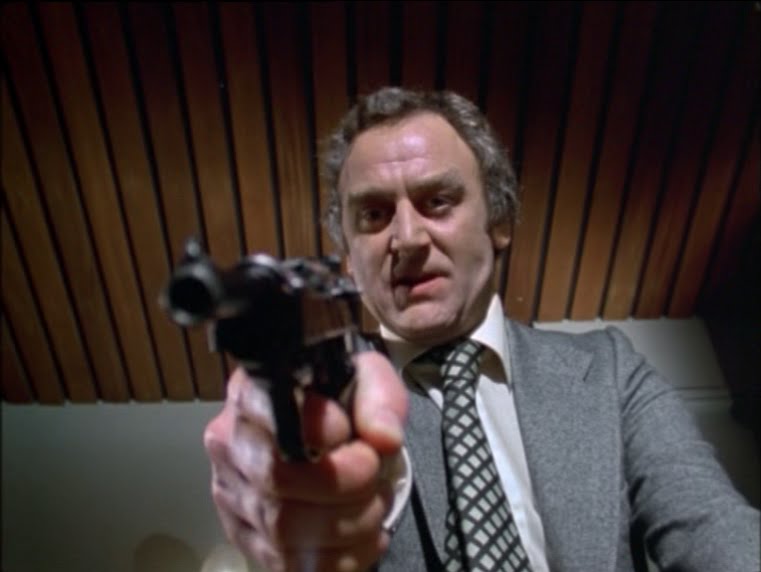
In the annals of British TV police series, few shows have been as influential or as important as The Sweeney. Starring John Thaw – the future Inspector Morse – as DI Jack Regan and Dennis Waterman – the future Minder – as DS George Carter of the Metropolitan Police’s ‘Flying Squad’, the show spawned imitators (Special Branch), homages (Life on Mars) and movies (The Sweeney), and even influenced the then-new Flying Squad themselves, showing them how to be the Flying Squad.
What’s not as well known is that The Sweeney actually started as one of Thames TV’s Armchair Cinema season, the continuation of ITV’s Armchair Theatre play series. It was written by Ian Kennedy Martin – the brother of Z-Cars (and The Italian Job and Edge of Darkness) writer Troy Kennedy Martin – with John Thaw in mind, Kennedy Martin having been script editor on 60s show Redcap, of which Thaw was the star.
Most of the essential elements of The Sweeney are here, so see below how the show started, in today’s Wednesday Play.
Inspired by Scarfolk, the English town that still lives in the 1970s, we’re continuing with this ‘ere blog’s latest feature: Charley says.
The 1970s was a terrible time, of course, where the risks to people from everything from electricity cables to water to other people could not be overstated. It was horrifying. Particularly the rabies.
To save the public from these threats – and themselves – the British government authorised a series of public information films designed to scare the living daylights out of anyone who watched them. And each week, I intend to scare the living daylights out of you with a public information film or two – watch them, as they might just save your life.
You may, by now, if you weren’t alive in the UK in the 70s, wondering why the hell this is called “Charley says”. Well, Charley the cat was the star of an entire series of warning films for children, in which he passed on his sagely feline advice to the child he was with, who otherwise would have been tortured, dead or something even worse.
This week: strangers. Charley says: “Don’t talk to strangers.” He’s right, of course, children. Is there something worrying about the fact the stranger in this film walks like Mr Benn?
“Try this for a deep, dark secret. The great detective Remington Steele, he doesn’t exist… I invented him. Follow: I always loved excitement so I studied and apprenticed and put my name on an office but absolutely nobody knocked down my door. A female private investigator seemed so… feminine, so I invented a superior, a decidedly masculine superior. Suddenly there were cases around the block. It was working like a charm until the day he walked in with his blue eyes and mysterious past and before I knew it he assumed Remington Steele’s identity. Now I do the work and he takes the bows. It’s a dangerous way to live but as long as people buy it I can get the job done. We never mix business with pleasure, well, almost never. I don’t even know his real name.”
It’s hard for women to get to the top in business. Don’t believe me? Just check how many women are CEOs or members of the boards of directors for Fortune 500 companies.
The reasons for this are long and complicated, involving history, discrimination and a whole lot more. In particular, there’s perception. Some people, both men and women, don’t think women are going to be as good as men are at certain jobs.
Particularly private detectives. Or at least people didn’t in 1982, before VI Warshawski, Anna Lee and co. Certainly, Laura Holt (Stephanie Zimbalst) found it hard to get any work when she started out. She may have come top of her class at pretty much everything, but with her name on the door, for some strange reason, no one was interested in hiring her.
So crafty Laura Holt decided to invented a boss with a very masculine name: Remington Steele (Remington as in gun, rather than Fuzzaway). Suddenly, for some equally strange reason, people were queuing up to hire her – well, they wanted Remington Steele, but he was always out of town on business but somehow he always managed to solve his cases with the help of his ‘assistant’.
All was going well with this set-up until a movie-loving, very handsome con man (Pierce Brosnan) turned up and assumed Steele’s identity. Together, he and Holt end up working together, solving crimes. But would their relationship ever become more, when it was all founded in lies – hell, she didn’t even know his real name? Well… that would be saying.
Here’s the intro from the very first episode – the observant will notice the wording is different. After that, the full, rather catchy, Henry Mancini-scored theme tune, and then every episode title from the show, all of which were puns.
Inspired by Scarfolk, the English town that still lives in the 1970s, we’re continuing with this ‘ere blog’s latest feature: Charley says.
The 1970s was a terrible time, of course, where the risks to people from everything from electricity cables to water to other people could not be overstated. It was horrifying. Particularly the rabies.
To save the public from these threats – and themselves – the British government authorised a series of public information films designed to scare the living daylights out of anyone who watched them. And each week, I intend to scare the living daylights out of you with a public information film or two – watch them, as they might just save your life.
This week: water. If you aren’t terrified of water, you should be, you raving loon. What’s the matter with you?
Since I know a lot of you lovely readers are sci-fi lovers, today, I thought I’d give you the gift of one of the few sci-fi/fantasy plays that the BBC made in its standard drama strand, Play For Today. Based on Alan Garner’s novel of the same name, Red Shift is an odd little thing set in three time periods: Roman times, the Civil War and ‘modern times’. Linked by an artefact that appears in all three periods, a stone axe, the play looks at the plight of three different men, all faced with different challenges of the time, usually involving women. In the Roman period, some Roman deserters are in hiding, except the enemy may be within (or it might be the Celt woman they have prisoner, who might actually be a local goddess); in the Civil War, the goodies (including James Hazeldine) are holed up in a church, trying to escape from some Royalists; while in the present time, a somewhat pretentious student is vexed by his girlfriend and his parents.
To a certain extent, the story defies description, losing some aspects of the novel in translation to TV. The stories are linked more or less only by location, although the themes of adolescent angst, religion and control/lack of control of women are still there in the play. As a result, it’s more fascinating to watch mainly for the third story to see what ‘modern values’ were in 1978, with the pretentious student living with his parents in a caravan, and they being unwilling for him to have sex with his girlfriend. It’s also fun to see how little traffic there was in motorways in those days.
I won’t pretend it’s the greatest play ever and the specialised science-fiction strands at the BBC produced far superior work. But it’s a worth a watch out of historical curiosity and to see something that doesn’t give easy answers.