It’s nearly November, which means as far as TV is concerned, Christmas is just around the corner. Normally, you might choose to celebrate by watching It’s A Charlie Brown Christmas, but this year, you now have the option of watching ‘Merry Christmas Will Byers’, a sequel of sorts to Stranger Things done in the style of It’s A Charlie Brown Christmas. It’s really quite delightful, so give it a watch. You’ll need to have seen Stranger Things first, of course.
For most people in the UK, Hugh Laurie is Hugh Laurie. He may have played Gregory House in House for umpteen seasons, but he’s also the guy from Blackadder, Bertie Wooster in Jeeves and Wooster, and Stephen Fry’s comedy writing partner for most of the 80s and early 90s.
For most Americans, though, he’s House. He is the grumpy, misanthropic, genius American doctor from House. End of. So you can kind of understand why Laurie would take on a two-season role as an eponymous doctor again, if only to cleanse American viewers’ memories by playing something similar, but crucially different in one big regard: he’s nice.
Based on the novel by Ken Humm (John from Cincinnati), Chance sees Laurie playing a consultant psychologist, who tries to sort out treatment for people who have neurological problems. When Gretchen Mol (Life on Mars) is referred to him with disassociative personality disorder, which she says started after her cop husband Paul Adelstein (Prison Break) began to abuse her, he tries to help her but soon the husband is coming after him.
Meanwhile, the non-confrontational Laurie is in the middle of a no-fault divorce from his wife Diane Farr (Numb3rs) and needs money. When he takes his antique desk to Clarke Peters (The Wire) to be sold, Peters tells him he could get nearly twice as much money if it still had the metalwork on it. Fortunately, Ethan Suplee (My Name is Earl) works for him and could add the missing metalwork if Laurie doesn’t mind a little deception. In turn, Suplee doesn’t mind a little bit of ultra-violence and is potentially willing to help Laurie out with his other problem…
I’ll play a little game now. I’ll list a few things and you have to say at which word you realised what the show’s biggest influence is.
San Francisco. Psychiatry. Blonde. Femme fatale. Different personalities. Hitchcockian strings.
Well, if you haven’t got it already, the answer’s Vertigo, one of Alfred Hitchock’s finest, in which Jimmy Stewart falls for Kim Novak who plays two women who turn out to be just the one. Certainly, Chance has huge ladels of both Vertigo and film noir spread all over it. There’s also lashings of Woody Allen’s Crimes and Misdemeanours, with Suplee and Peters leading the normally ethical Laurie towards a life of escalating moral infractions towards possibly even murder.
But Chance is certainly a lot more than that and knows that you know what its references are. Certainly, Laurie doesn’t do anything massively stupid, instead doing all manner of smart, prudent things rather than leaping in at the deep end. There’s also a certain House of Cards – David Mamet’s, that is – quality to it all which the show is also keen to highlight. Is maths tutor Mol really disassociative or is she faking it? Is Adelstein really doing all the things that he seems to be doing or is the surprisingly bright Suplee actually doing it all to lure Laurie into a huge con? Could they even all be in league with one another?
Chance wants you to be wondering all of these things, which is why, despite its depressing qualities, it’s also compelling, very tense and claustrophobic (rather than vertiginous). The double meaning in the title, which becomes hugely important in the second episode, makes you wonder exactly how much of what’s going on is genuine coincidence and what’s not – or even if Laurie’s character is facing a Sixth Sense discovery that he’s had a brain injury himself. Even if you’re not exactly sure what the trap is, you can feel the jaws slowly closing around Laurie, who’s a good guy who wants to do the right thing.
It’s a good, smart, well-paced thriller that’s definitely worth a try.
Barrometer rating: 2 Would it be better with a female lead? No TMINE’s prediction: Commissioned for two seasons
The problem with Falling Water, USA’s new sci-fi thriller about three people who find they’re sharing dreams that give them insights into the real-world, is that the dreams are almost indistinguishable from reality. You might think this a good thing, as one of the better things about the otherwise soporific pilot episode was its Francis Bacon-inspired and often surreal dream sequences. And indeed some of the dreams featured in the show have been engrossing, disturbing, fascinating and mind-bending. Certainly, you’d be excused for watching Falling Water simply for the dreams.
And if Falling Water‘s principal plan is to make us doubt reality or question what is real and what is dreamt, it might be on to something. The trouble is that the show seems to want to have its cake and eat it, by making us want to doubt reality yet still arguing there is a reality – but one that’s so stupid, it might as well be a dream.
The essence of the show is a bonkers conspiracy theory involving shady international commodities dealings, 70s folk singers, a creepy child and a suicide cult that wears green trainers. It’s hard to watch all of that without thinking that unless it’s all revealed to be absolute nonsense in some Inception-like third layer of dreaming, Falling Water is YA serial TV show with a ridiculous McGuffin that will disappoint anyone who stays to the end of the season and/or series.
Which is a shame, because the show does have some great imagery, some fine performances and those dream sequences. Okay, it moves at glacial speeds and it’s only at the end of the third episode that the three dreamers (Lizzie Brocheré, David Ajala, Will Yun Lee) whose individual stories we are following come together for the first time, but it’s still fascinatingly odd, without exhibiting the worst laws of Netflix’s similar Sense8.
I’m probably going to keep watching this, because of the visuals, its oddness, Ajala and Yun Lee, but it’s not a show I’d recommend starting if you’re not already watching yourself.
Barrometer rating: 3 Would it be better with a female lead? If it was a different lead to Brocheré then yes TMINE’s prediction: Cancelled by the end of the season
Adaptations are a funny old thing, aren’t they? Sometimes you find out more about the person – or country – doing the adaptation than about the original material.
Take Dirk Gently’s Holistic Detective Agency, a Douglas Adams book written in the 1980s based on scripts he wrote for Doctor Who. It sees the eponymous chubby detective investigating Cambridge colleges, time machines, Electric Monks, the creation of human life and impossible sofas, all in the belief that everything is interconnected and that if he investigates one thing, no matter how seemingly unrelated, he’ll end up solving the original mystery.
The story was adapted for BBC Four six years ago by Misfits‘ Howard Overton, spawning a TV series two years later. How much was it like the book? Not much, despite strip-mining all the good stuff from it, but it was very BBC Four, with bumbling English people and a budget of 50p.
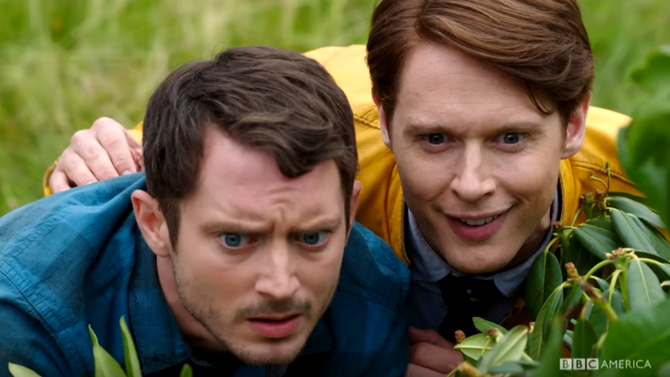
Now we have Max Landis and BBC America’s efforts, which are even less like the book, but do at least have a character of their own. A continuation of sorts to both Dirk Gently’s Holistic Detective Agency and its follow-up, The Long Dark Teatime of the Soul (judging by the references to both sofas and Thor), it sees Dirk (Samuel Barnett) relocated to Seattle where he’s hired to investigate the death of reclusive millionaire Julian McMahon (Charmed, Fantastic Four, Nip/Tuck, Hunters, Childhood’s End)… by McMahon, six weeks before he’s murdered.
One of the few witnesses to the murder is bellboy Elijah Wood (Wilfred, Lord of the Rings), who has his own problems with his drug dealer landlord, his hallucinating ill sister Hannah Marks (Necessary Roughness), a corgi, and the police who are following him, including Richard Schiff (The West Wing). But when Barnett breaks into Wood’s apartment because it looks interesting, Barnett decides Wood is prime ‘assistant’ material and the two end up holistically intertwined.
It has to be said that the show is odd. Very odd. Very odd at odd moments. Just as everything looks like it’s settled into one form of odd, a time traveller will appear, a holistic assassin will start macheting people at random, four guys in a van will start sucking someone’s soul or bullets will richochet off a pipe and kill the kidnapper in the flat above. New odd is here – get used to it for the next five minutes because there’ll be another one along in a minute. Ooh look, it’s a musical number!
Which is both in keeping with Adams’ writing yet simultaneously quite Landis (cf American Ultra). On top of that, there’s an American quality to it all – Barnett is less a schlubby ne’er do well in a silly leather hat, more an American’s idea of an eccentric Brit via Harry Potter. There’s also a distinct air of ‘improving one’s self’, with Wood’s embracing of Barnett’s holistic philosophy leading to his life becoming significantly better, and the familial side of things with Marks and Wood is almost heartwarming in an American stylee.
I’m not sure whether this Dirk Gently is a huge improvement over the previous one, though. Barnett’s too young to really work as Gently – Schiff would have been perfect – and Wood is basically just doing the bamboozled sidekick routine he perfected in Wilfred. There was also never a point where I felt myself relax into the show enough to genuinely enjoy.
But it does at least feel a lot more like Dirk Gently, despite having nothing at all in common with the books beyond themes, it’s full of what look like potentially interesting ideas and there’s enough life in the supporting cast at least that it’s worth watching for them.